

Noticias y recursos
GUEST PERSPECTIVE
When Art and Music Create a Shared Listening Space
Giovanni Acquilino, 2025 Cohort Member, Global Leaders Institute
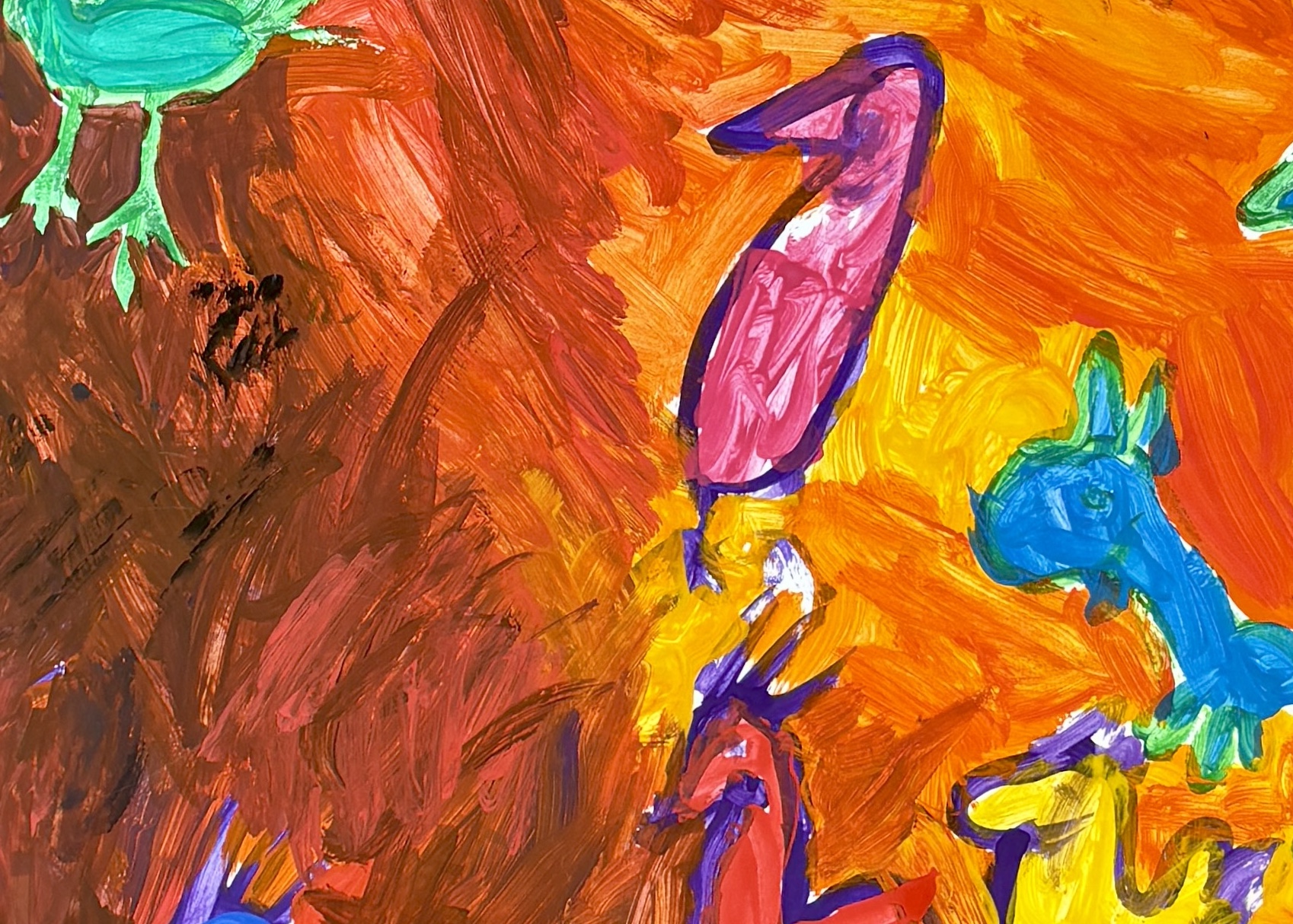
NKO art. Photo: Giovanni Acquilino.
What does visual art have to do with listening?
It’s an unusual question—but one that’s well worth exploring, as I discovered recently when I attended Sguardi Paralleli (Parallel Glances) – Art Therapy and Autism: Art as Language, an exhibition held in Alassio, Italy and curated by art therapist Carla Paura.
At the center of the exhibition was the artistic journey of NKO (Nicolò), a 12-year-old autistic artist whose visual work has developed over the years through a deep relationship with sound, music, and listening environments.
“With Nicolò, the therapeutic process used gesture, timing, shared rituals, color, and listening as tools for relationship and communication. Art became a language through which he could process experiences, express emotions, and progressively strengthen verbal communication as well,” says Carla Paura, who has accompanied Nicolò in a remarkable six-year developmental journey, as his initially uncertain marks gradually became vivid, intense, and deeply expressive artistic gestures.
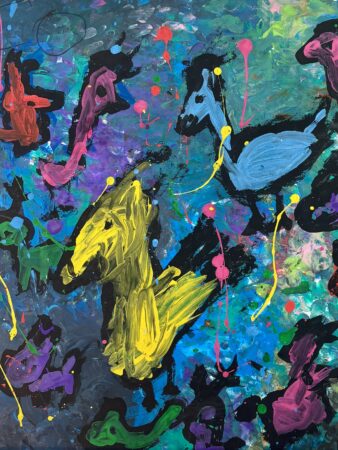
In the exhibit, each artwork was accompanied by a QR code connected to musical pieces, soundscapes, or listening atmospheres chosen by NKO and linked to his creative process, together with his brief personal reflections. Visitors were not simply standing in front of artworks to observe them. They were entering a space of listening, relationship, and shared presence.
As I watched people move through the exhibition, slow down in front of the artworks, remain in silence, and listen attentively, I realized that the experience was suggesting something that went beyond the relationship between artistic disciplines. It was also saying something about music education, ensemble practice, and the kinds of communities we are still capable of building through listening.
An ensemble rarely functions through technical instruction alone. It functions when a form of relational listening emerges: the ability to perceive presence, intention, gesture, timing, silence, and the actions of others within a shared space.
These are artistic dynamics, but also, above and beyond that, profoundly human ones.
What struck me most about the exhibition was not only the opportunity it offered NKO to express his inner world through art, but also the quality of attention that formed around the artworks themselves. Sound, images, silence, storytelling, and shared presence generated an unexpectedly gentle, attentive, and cohesive environment. For a few moments, that room seemed to function like an ensemble: different people orienting themselves together through reciprocal listening.
This experience also led me to reflect on how music education can sometimes become overly dependent on continuous verbal explanation. In many creative, inclusive, or neurodivergent contexts, forms of coordination and listening often emerge naturally through observation, shared time, gesture, and relationship.
This does not mean removing words from teaching. It simply means that forms of non-verbal interaction—such as moments of silence, collective breathing, guided improvisation, immersion in soundscapes—can become integral parts of the musical experience itself.
Likewise, multimodal environments that combine sound, image, movement, and space can offer alternative pathways for participation and learning, allowing different students to connect with music through different yet equally meaningful channels.
Within ensemble practice, this may involve designing rehearsals and performances in which listening is treated not only as a technical skill, but also as a shared practice of attention. For music educators, as for all educators, it’s important to remember that listening itself can become an educational structure.
Contenido relacionado
All Regions, Collaborations, Community Building, Events/Performances, Gather Together, News and Resources, Professional Development
Students in the League of American Orchestras
Patrick Scafidi
All Regions, Collaborations, Community Building, Events/Performances, Gather Together, News and Resources, Professional Development
Apply for ESUSA’s Youth Leadership Institute
Patrick Scafidi
All Regions, Collaborations, Community Building, Events/Performances, Gather Together, News and Resources, Professional Development
Creative Economy Career Pathways for Youth
Patrick Scafidi
Collaborations, Community Building, Europe, Featured, Gather Together, Italy, Program Design, Teaching & Learning
A Living Network Meets in Milan
Patrick Scafidi


