

Topics
News & Resources
EDITORIAL
When an Instrument Case Means ‘Don’t Shoot’: Symbolic Recognition in Medellín
Nathaly Ossa Alzate, strategic arts management and social impact consultant
Last year, while wrapping up my Master’s thesis in Education and Social Change at the University of Oslo, I reconnected with the friends I grew up with in the first generation of Medellín’s Red de Escuelas de Música (REMM) in Colombia, a revolutionary program many of you know well. I wanted to step past the initial “warm glow” that often follows a great youth concert and turns it into a nostalgic memoir, and ask a deeper, enduring question: two decades after stepping out of the classroom, how did this early experience actually influence who we are now, as adults? Through interviews that used a “life-history” methodology, I was able to explore how my fellow alumni constructed meaning around their time in REMM.
We often talk about music programs in terms of material resources: giving kids instruments, free lessons, safe spaces. But what kept coming up in these conversations was something far more profound: symbolic recognition.
In Nancy Fraser’s framework, social justice requires both redistribution (economic resources) and recognition (cultural and symbolic status). Symbolic recognition is the validation of one’s identity, dignity, and self-worth within a broader socio-cultural context. And in 1990s Medellín—our time—young people faced both material deprivation and severe symbolic misrecognition, often being viewed solely through the lens of urban violence, stigma, and invisibility.
Still, we all agreed that when we joined the music school as children, our relationship with the city shifted radically. Alumni vividly remembered those first moments of newfound visibility. Said Tim, “At school, they would say over the megaphone: ‘Students from the music school may leave for rehearsal,’ and I would proudly get up.” Flavio echoed this: “Just saying you were part of REMM opened doors. Even in the neighborhood…people would say, ‘Hey, you’re one of the cellists from the orchestra!’”
Suddenly, we were no longer defined as “at-risk youth on the periphery.” We were cellists, percussionists, and artists. Our value was no longer framed around mere survival but around creative contribution.
Perhaps the most striking revelation was the physical presence of the instrument itself. In working-class neighborhoods, carrying an instrument case became a mobile signifier of distinction—and, sometimes, survival.
One participant, Anna, recalled walking through high-risk streets with a violin case: “At first it was hard… but over time, those cases became a sort of symbol. They also worked as a kind of ‘Don’t shoot’ signal. I think that really did change something, even though I still felt very unsafe.”
Read that again. A violin case became a shield, a physical marker that re-signified a child in the eyes of their community, transforming them from a potential target or suspect into a student, an artist, and a child with a future.
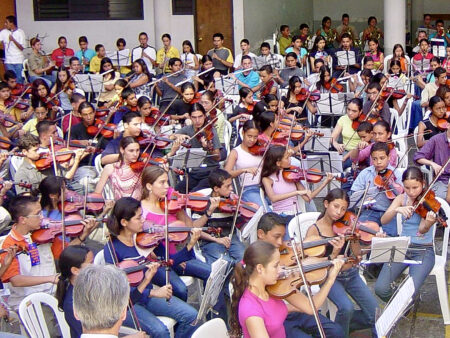
We’ve all seen the magic of international tours, playing in grand halls and traveling abroad. For these young musicians, traveling unlocked a world of privilege previously out of reach. Standing on those stages gave whole communities a newfound sense of possibility and pride. We were no longer defined by hardship; we were recognized as ambassadors showcasing the very best of the city and country, a role recognized in 1999 when UNESCO awarded REMM the title The Other Face of Medellín to the World.
Carlos remembered playing at the Vatican when he was just twelve years old, realizing his family and friends no longer saw a child of circumstance, but an ambassador of beauty. He shared, “When I wore the Colombian flag on stage, I felt like an ambassador. I really meant it.”
Researchers like Brydie-Leigh Bartleet often caution, with reason, against the “warm glow” effect, that temporary high from a community music project that fades as soon as everyone returns home to their daily realities. But 20 years later, these alumni prove that the right kind of symbolic recognition doesn’t fade.
By granting children public dignity, material tools, and relational belonging, programs like REMM help young people move from constrained beginnings to what I call the relational agency of co-responsibility, becoming active, ethical contributors to their societies.
As music educators, program leaders, and advocates in the Ensemble community, we know that when we give a child an instrument, hand them a concert dress, or call their name, we are giving them a platform to be seen. We are offering them symbolic recognition in a world that too often ignores them.
Two decades later, my friends and I aren’t just remembering the notes we played. We recognize that we are living out the agency, dignity, and purpose that symbolic recognition, given at the right moment, helped to build inside us. And that, I believe, is one of the long-term superpowers of our collective work.
Related Content
All Regions, Collaborations, Community Building, Events/Performances, Gather Together, News and Resources, Professional Development
Suggested Reading: The Heart of Teacher-Student Relationship
Patrick Scafidi
All Regions, Collaborations, Community Building, Europe, Events/Performances, Gather Together, News and Resources, Professional Development
Grants for Underserved Communities Across the Globe
Patrick Scafidi
Collaborations, Community Building, Featured, North America, Program Design, Student Voice & Leadership, Teaching & Learning
In Overlooked Spaces, Art and Dignity Flourish
Patrick Scafidi
Africa, Belgium, Community Building, Featured, Kenya, Program Design, Teaching & Learning
Reaching Across Continents to Help Children Make Music
Patrick Scafidi


