

EDITORIAL
Young People Are Speaking To Us. Are We Close Enough to Hear Them?
If you have not yet read Ayde Diaz’s editorial titled “The Power of Youth Voice” in last month’s issue of The Ensemble, please read it now. Her article pointedly calls for adults to recognize how much our work improves when we listen to what young people have to say.
I first read the article as I approached the end of my September to November “conference season.” I’d been missing the presence and perspective of young people in these gatherings dedicated to arts education, young people’s wellbeing, and community health through the arts. When young people were present, it was most often as performers, and occasionally as panelists alongside adults.
Throughout these events, I had been wondering, “How is it that we continue to position young people as objects of conversation, and not the subject?” By this I mean that when adults are talking about young people, they are an object being discussed by others. This also happens when one or a few young people are on a panel in a room full of adults without their peers in the audience. They become objects for the audience, too easily perceived as representative for all youth. This is exacerbated when the young speakers are only present for their panel and don’t have the opportunity to engage with attendees or to be part of dialogue or content beyond the limits of their time on the dais. This doesn’t have to be the status quo.
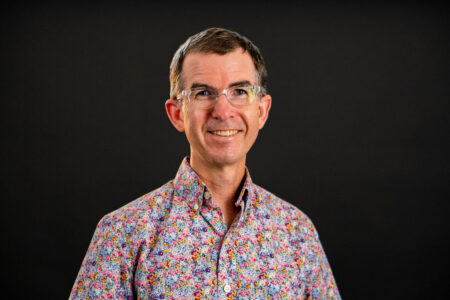
Of the nearly 15 conferences I’ve attended this year, only one was fully curated by young leaders. It felt different, with its mix of creative and kinesthetic activities, a role-playing game, and a kick-off that ended with grantmakers dancing between dinner tables!
Ayde’s article gave voice to the richness of youth leadership I’d been missing at too many convenings. This isn’t surprising, considering how clearly she connects her participation as a Youth Ambassador at El Sistema USA’s regional gathering to her discovery of how valuable it is to simultaneously hear from peers and be heard by adults. She distilled this learning into a simple truth: “I realized our ideas aren’t background noise—they’re the heartbeat that makes these programs work.”
This truth is evident at so many creative youth development programs across the United States. Young people are the activist artists at Hip Hop Into Learning in Louisville, KY. They guided the design of RYSE Center’s building in Richmond, CA. At Community MusicWorks, they gathered community stories from elders in their city of Providence, RI to inform the neighborhood about the resource roles CMW’s new building would play. Young leaders facilitate the daily listening circle at Neutral Zone in Ann Arbor, MI.
The most obvious example of young people being “the heartbeat that makes these programs work” is the transition many participants make from student to teaching artist at the program where they grew their talents and matured as people. This occurs across the United States and around the world.
We must heed this truth that Ayde has named and bring our approaches to intergenerational collaborative leadership into wider gatherings. And we must bring people from these gatherings to our programs, so they can experience it for themselves. This is what my colleague Karen Cueva and I did with The H.U.B.B. Arts and Trauma Center in Newark, NJ, during New Jersey Performing Arts Center’s Creating Healthy Communities convening.
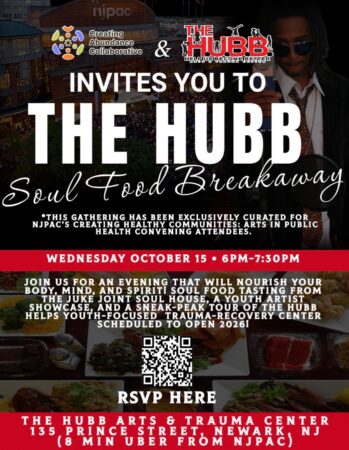
Together, we hosted a “Dinner-Hour Breakaway” between the afternoon and evening conference activities. Young artists welcomed us as we arrived and hosted tours of The H.U.B.B, including the new trauma recovery center facilities under construction. They performed for us and for one another, and they shared stories about how they contribute to their community through all they learn at The H.U.B.B. This was a fully youth-led experience for the 40+ people who attended. Our organization, Creating Abundance Collaborative, simply underwrote the buffet soul food dinner catered by a local restaurant and coordinated with the conference organizers to add the Breakaway to their event app.
Afterwards, we heard how much people appreciated being immersed in the maturity and dedication of young people in a setting that had a family feel. There was no mistaking it: young people were the authorities in the room, ushering us through the evening.
This is what we need more of. To achieve it, we have to rethink and redesign how we gather. All too often, we sit in auditorium-style sessions that prioritize a single mode of learning and inhibit relationship building. It’s even more stifling when we do this in generic hotel conference rooms.
We know this isn’t an optimal way of learning. That’s why we devote so much energy into making our program spaces beautiful, inviting, and representative of the families we serve. We don’t use lecture-style approaches; we prioritize experiential and collaborative projects. We make time and space for sharing ourselves, such as in the listening circles mentioned above. We simply need to bring what we know is most effective in our program environments into our conferences and convenings.
The ideal guides for doing this are young people. I’m confident that in addition to helping us update how we organize people and time at conferences, they will compel us to have more fun. By having more fun, we’ll better be able to fully grapple with the complicated truths and challenges that surround us. We’ll return from such gatherings invigorated and inspired to invest even more in the leadership of young people.
Contenido relacionado
Collaborations, Community Building, Funding & Support, News and Resources, North America
Presser Foundation Grants for US Music Initiatives
Patrick Scafidi
Collaborations, Events/Performances, Middle East, News and Resources, North America
Dubai’s NYO Is First UAE Orchestra to Perform at Carnegie Hall (Plus Some Bonus Music Resources)
Patrick Scafidi
Africa, Collaborations, Community Building, Gather Together, News and Resources, Nigeria, Perspectives & Collective Action, Teaching & Learning
Goalkeepers Event Showcases the Power of Music across Africa
Patrick Scafidi
All Regions, Community Building, Featured, Gather Together, Teaching & Learning, the world ensemble
Arts in Action: Case Studies by Global Leaders Institute Fellows
Patrick Scafidi


