

Topics
News & Resources
Solving the Instrument Crisis in Global Music Education Programs
Graciela Briceno, Program Manager, In Concert Opus Network
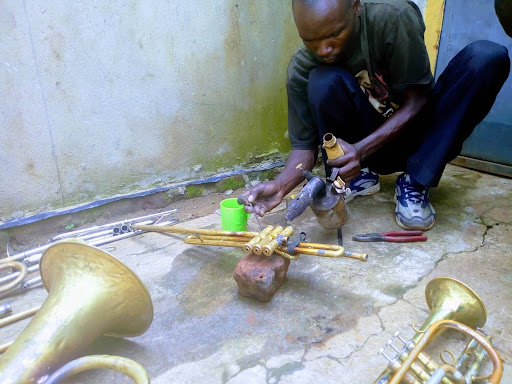
Repairing brass instruments. Photo: Kyewalyanga Fredrick, Save the Music Foundation.
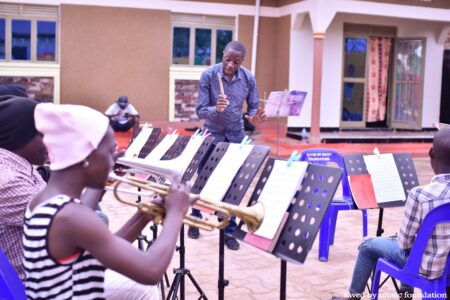
The image is jarring: a vibrant green lawn scattered with brass instruments in various forms of disrepair, some rusted, others broken or bent. A few rest in old cases with broken hinges. A video showing that image was shared by Kyewalyanga Fredrick (Freddie), founder of Saved by Music Foundation, a nonprofit in Uganda that serves 111 children between the ages of 8 and 16. Alongside providing shelter, food, healthcare, and school fees, the program teaches music through the Elgon Youth Brass Band, which rehearses every day. Unfortunately, like a majority of programs in the region, Saved by Music Foundation does not have enough playable instruments for all of its students.
In Concert’s Opus Network recently conducted a qualitative study of music for social impact programs across Sub-Saharan Africa, Latin America, and the Middle East. Twenty-seven programs were interviewed about their successes and operational challenges, with 81% saying that acquiring and maintaining instruments is a constant struggle, given expensive transport costs and import fees. Many regions across Africa face a severe shortage of specialized tools and have limited (if any) access to trained repair technicians. Meanwhile, programs in tropical areas of Latin America can often source instruments but lose them rapidly to climate damage, high humidity, and a lack of appropriate storage spaces.
These challenges create bottlenecks that prevent programs from serving current students or expanding. Even with passionate leadership and dedicated teaching artists, a program that cannot acquire or maintain instruments will experience operational decay. For every instrument that breaks, the ensemble potentially loses one child (or more). As Freddie commented, “We’ve had brass instruments sitting with a partner in the United States for over three years, but we have been completely unable to raise the necessary international shipping fees and clearance costs to get them here to the academy.”
Most programs are not looking for just any instruments. They are in need of specific inventory to maintain orchestral balance or run structured curricula that enables students to develop the skills that ensemble-based learning can provide. Sourcing smaller, child-sized string instruments (e.g., ¼- and ½-size violins) is especially difficult. Programs that cannot afford import fees often have to give small children full-sized instruments, which hinders their technical development. Meanwhile, woodwind and brass ensembles, such as those in Ghana and Uganda, find themselves stuck by the ongoing cost of materials (e.g., clarinet reeds, valve oil, slide grease). One program in Ghana noted that their activity sometimes grinds to a halt simply because they run out of woodwind reeds, which cannot be purchased locally.
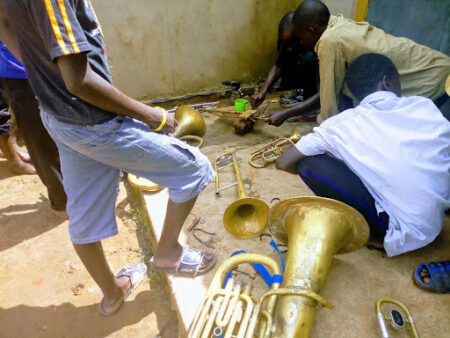
Securing an instrument is half the battle; keeping it playable in challenging climates is the other. In many parts of the world, there is a deficit of trained instrument repair technicians. If a violin cracks or a trumpet valve becomes stuck, the instrument is unusable indefinitely. Programs are often forced into workarounds just to keep students playing. Sharing photos of his team attempting makeshift repairs on brass instruments, Freddie noted, “At the moment, someone with no experience repairing brass instruments is helping us because we have no other option.”
Where professional repair options do exist, they are often logistically or financially out of reach. Imagine paying transport costs higher than the value of the instrument for a seam repair or a pad replacement. Another program director from Latin America said, “The humidity here destroys string seams and rots woodwind pads within a single season. Without local repair skills, a small grant is swallowed instantly just trying to source replacement parts.”
While donating instruments will always be important, international shipping fees and customs delays make this option difficult to implement. Our best strength is our global community: we create more immediate impact by training teachers and program directors in repair techniques and creating “repair kits” with commonly used supplies. In the months ahead, In Concert aims to facilitate these connections, bringing together directors, teaching artists, and professional repair experts around the world in an exchange of instructional videos, short WhatsApp consultations, or scheduled workshops with experts who know best practices on maintaining instruments with limited resources. Our goal, as ever, is to enable more children to experience the many benefits of instrumental music-making.
We cannot let supply chain failures silence these ensembles. Whether you can sponsor a repair kit, provide virtual technical training, or connect us with instrument and supply donation partners, we need your care and expertise. Reach out to [email protected] to get involved.
Related Content
All Regions, Collaborations, Community Building, Events/Performances, Gather Together, News and Resources, North America, Professional Development
Music Matters Challenge Open to U.S. Musicians and School Music Programs
Patrick Scafidi
Ambassadors, Collaborations, Community Building, Featured, Gather Together, Latin America, Perspectives & Collective Action, Student Voice & Leadership, Teaching & Learning, the world ensemble
Through Songwriting, Colombian Communities Resolve Conflict and Make Their Voices Heard
Michael Gutierrez
All Regions, Collaborations, Community Building, Gather Together, News and Resources
U.S.-Venezuela Relations Impact Music Exchange Programs
Michael Gutierrez
All Regions, Community Building, Editorials, Gather Together, Opinion, Perspectives & Collective Action, Professional Development, Program Design, Student Voice & Leadership, Teaching & Learning, the ensemble
EDITORIAL
Musical Benchmarks Build Equity
Patrick Scafidi


