

Noticias y recursos
EDITORIAL
A Question We Could Not Answer
Faly Ranaivoson, Founder, Choir Orchestra Loharano (COL)
One of our longest-standing members asked a question at a meeting this year that I still cannot answer well. He had rehearsed four or five pieces for our concert last December. On the afternoon itself, he participated in playing only one of them. He wanted to know how that had come about. He put his question to everyone in the room.
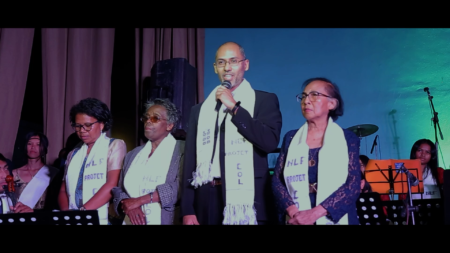
I heard no complaint in the question. He was curious. Our players met several times that week. Members were free to attend as many meetings as they could; he came to all of them and spoke at each, but he asked his question only at the last meeting. I knew how easily such a question could be swallowed, and how often an empty chair follows.
Choir Orchestra Loharano (COL) is a choir-orchestra in Antananarivo, Madagascar, now in its fourth year and still under construction, as we tend to put it. It brings together around 130 players and singers, most of them young, with seven teachers. The man who asked the question retired from working life not long ago and has been with us almost since our beginning.
I gave him two answers. The first was that belonging to COL does not vary with how much you contribute or how often you are present. The second was that everyone who walks onto a stage carries a responsibility to the players beside them and to the people who came to listen. I believe both of those answers. But they still did not sufficiently answer what he had asked.
His question opened a harder inquiry. Some members come to only a handful of rehearsals before a concert and still play well in performance. Others come every week and yet still are not as good. When not everyone who has prepared a piece can play it, who belongs on the stage? I do not have an answer. I imagine that many of you do not, either, and that you have felt the cost of whichever way you decided.
Johary, our executive director, had spent several weeks meeting every learner one by one, and finished just days before those meetings. It was the first time we had met with every learner individually: our work happens in sections during the week and as a full ensemble on Saturday afternoons. Johary called these meetings “auditions,” but their purpose was not selection; it was to notice gaps in what each of them had learned. What he reported back from these meetings was a risk rather than a verdict: If we do not give the fundamentals a proper share of the time, the orchestra will stall.
This is the most useful thing I can pass on to you, my readers. A gap in polish can be closed by a deadline: the piece is nearly there, and the imminence of performance brings it home. But a gap in fundamentals can be hidden by a deadline. You can bring three pieces to the stage without the participants having become better musicians at the end of the concert. It gave me a clear way to tell these two kinds of gaps apart: faced with a new piece of comparable difficulty, would the orchestra members know how to begin?
Many programs make performance frequent, local, and low-stakes. We play in public when we are asked… twice this year, at a wedding in June and at a church celebrating its 155th anniversary in July. But our annual COL concert was the one date that governed everything around it, and its rarity had given it too much power.
So the first change we need to make is not about the planned event but about the work. We have decided that from August to December, more sections will work in level-based groups, and we will restore the time for fundamentals that concert preparation had absorbed. Advanced learners will begin helping beginners; teaching will form them as much as it helps those they teach. Our weekly full-ensemble rehearsal can then bring together what the sections already know. That is the outline; the teachers will shape the work.
In December there will be a whole-day gathering rather than a discrete concert, for families, friends, and whoever our members invite. At its center will be one shared piece arranged in layers, so that every level has a part that is realistically within reach. The beginners will be neither hidden nor exposed; the advanced players will be stretched. Together, the learners will host the day.
This new plan is not a complete answer to our long-standing member’s question. But we hope it is a good first step in our inquiry: we are trying to make each person’s place in the day depend less on being chosen for one of a few visible parts. His question has changed the way we do our work. As always, we are still under construction.
Faly Ranaivoson divides his time between Geneva and Madagascar.
Contenido relacionado
Todas las regiones, Colaboraciones, Construcción de la Comunidad, Editoriales, Juntos, el mundo en conjunto
EDITORIAL: El poder transformador de los grandes
Patrick Scafidi

América del Norte, Perspectivas y Acción Colectiva, el conjunto del mundo
Celebrando la cultura de la diáspora africana con el castillo de nuestras pieles
Patrick Scafidi
América Latina, Perspectivas y Acción Colectiva, el conjunto del mundo
El Proyecto Bach de Yo-Yo Ma se reúne con la Red de Escuelas de Música de Medellín
Patrick Scafidi
Asia, Asia/Oceanía, Diseño de programas, el conjunto del mundo
Sistema Aotearoa crece en Nueva Zelanda
Patrick Scafidi


