

Creating a Community of Belonging at OrKidstra
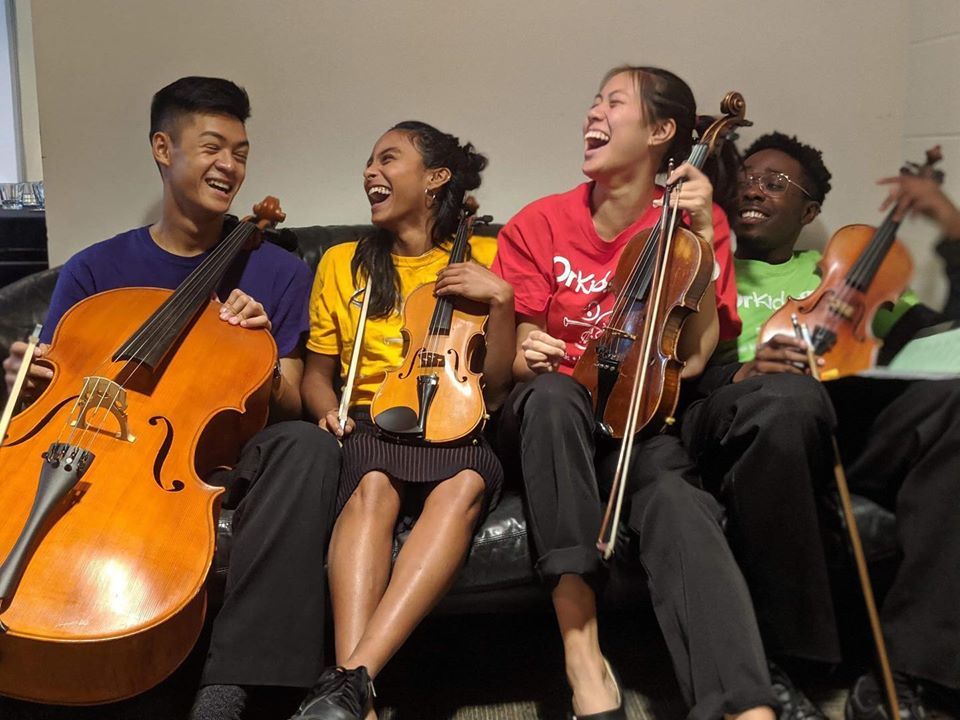
Gareth, Rinila, Jennifer, and Kafele enjoying the Canadian Museum of History together, September 2019. Photo: OrKidstra.
When you walk down the halls of OrKidstra, you’ll hear the universal language of music around every corner. Laughter as the kids rush to the snack table during their break. And you’ll hear something distinctly Canadian: the beautiful sounds of a community composed of 62 different cultural and linguistic backgrounds. A community of belonging.
Since 2007, OrKidstra, located in Canada’s capital city of Ottawa, has provided a welcoming, kid-powered space where students from all backgrounds can thrive. At the heart of OrKidstra is an aim to nurture a harmonious, inclusive environment that reflects and celebrates Canada’s rich mosaic.

Varied cultural knowledge is our most abundant resource, and not just because it deepens our work and expands our understanding of the world. Families value it. Melake, father of OrKidstra graduate Shan and younger siblings Sham and Dima, came to Canada from Eritrea with his family in 2011. He shares that “when [families and children] come here, they get to know each other, they communicate, and they have a very good relationship…children and families will have many friends from different cultural and ethnic groups. It’s really good for them.”
For Melake, the impact isn’t about any one group being centered. It’s about being in a place where many cultures come together with equal dignity—where difference is welcomed, relationships grow across communities, and surprising connections have room to form.
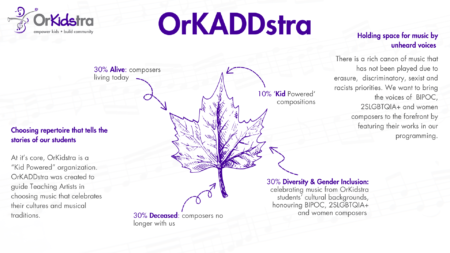
Grounded in our core values of Love, Courage, Excellence, and Belonging, our musical repertoire is designed to reflect the diversity of our community and create space for unheard voices. We took a major step toward that goal in 2021, when OrKidstra held facilitated conversations and feedback sessions with community and participating members to design the OrKADDstra repertoire guidelines. Short for K) Kid-powered compositions, A) Alive composers, D) Diverse and gender-inclusive composers, and D) Deceased composers, these guidelines inform our teaching artists as they choose repertoire that reflects the compositional voices, musical traditions, and lived experiences of our students and their families.
These guidelines have helped imbue our performances with a spirit of inclusiveness and exploration. Just last June, for example, we performed a significant composition by one of our graduating students, Colin Shen, called “Liminality”; two songs from our From War to Peace commission (more on that later), “Kahkiyaw Oskâyak” (Harmony) by Indigenous composer Sherryl Sewepagaham and “From One to One” (Togetherness) by Ismaili-Canadian composer Hussein Janmohamed; “Baba Yetu,” sung in Swahili; Japanese and French folk songs; and some contemporary favorites like Howard Shore’s Symphonic Suite from the Lord of the Rings—along with an arrangement of the last movement of Dvorak’s New World Symphony and Gershwin’s Rhapsody in Blue.
Even before OrKADDstra was formalized, we were embracing pluralism in the arts. Supported by a grant from the Canada Council for the Arts, esteemed Canadian composer Christine Donkin created a beautiful piece for choir and orchestra titled “Udo Shalom” in 2018. Celebrating the concept of peace, the piece is sung in over 30 different languages, from Maori to Estonian to Swahili to Korean to various sign languages. (You can view the world premiere here.) “Udo Shalom” concluded a seven-movement work titled From War to Peace; composed by seven Canadians of diverse backgrounds, each movement follows the arc moving through War, Otherness, Possibility, Hope, Harmony, and Togetherness, ultimately, to Peace.
Thankfully, not all of our participants had experienced each concept of From War to Peace firsthand. But all were able to understand those concepts in their own ways. To see our students come together to express those understandings through music reinforced the notion that our organization, like Canada itself, is richer and healthier for its diversity.
“Families sometimes ask how their child will manage in classes taught in English when it isn’t their first language,” says Emily Jenness, OrKidstra’s Program Administration Manager since 2019. “We always reassure them that many of our families are in the same situation, and our program gives the kids the opportunity to sing songs in a wide variety of languages.”
We celebrate this as much as we can. When we sing songs in different languages, like “Udo Shalom,” we ask our kids to guide the choir, to help with the pronunciation. They are the experts in the room. This not only empowers the students as creative leaders but also inspires the choir, the teaching artists, and the entire organization.
In the words of OrKidstra graduate and new Canadian Hadi: “At OrKidstra, I was able to communicate with others…who encountered the same issues as I did when I first came to Canada [from Syria]. Music was able to unify people—communicating with others in a language that we can all understand. [It] helped me launch myself into this new world.”
Try these links for more videos of OrKidstra in action: “Thank You Note” (14 languages) | “A short clip of Baba Yetu” | “Hymn to Freedom”
Contenido relacionado
All Regions, Community Building, Editorials, Gather Together, Madagascar, Opinion, Perspectives & Collective Action, Professional Development, Program Design, Teaching & Learning, the ensemble
EDITORIAL
A Question We Could Not Answer
Patrick Scafidi
All Regions, Collaborations, Community Building, Events/Performances, Gather Together, News and Resources, Professional Development
Participate in the Next SIMM Research Seminar (Applications Due Soon)
Patrick Scafidi
Collaborations, Community Building, Featured, Gather Together, Perspectives & Collective Action, Program Design, Student Voice & Leadership, Teaching & Learning, the ensemble, Volunteer
GUEST PERSPECTIVE
Why Willing Volunteers Still Don’t Show Up: How youth music programs can turn goodwill into support
Patrick Scafidi
All Regions, Collaborations, Community Building, Events/Performances, Gather Together, News and Resources, Professional Development
Music Education as an Economic Force
Patrick Scafidi


