
In Overlooked Spaces, Art and Dignity Flourish
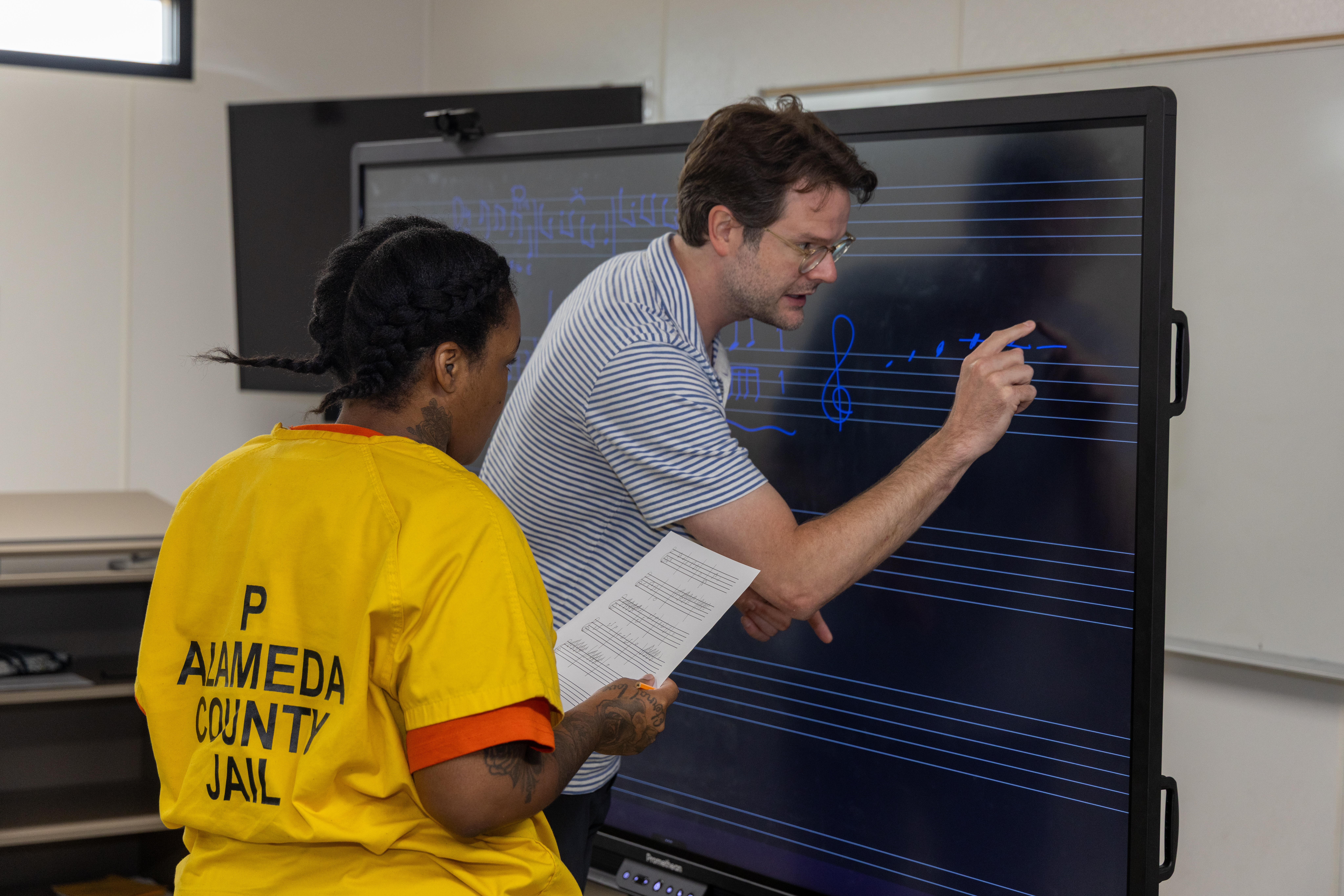
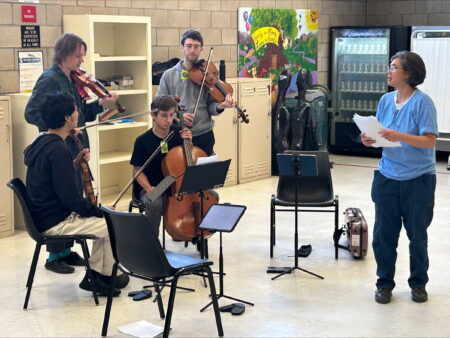
Teaching Artist Ben Grow works with a student during a Music For The Future residency. Photo: Alameda County Sheriff’s Office (ACSO).
In the winter of 2013, Project: Music Heals Us Founder Molly Carr shattered a glass bowl into her left hand on the eve of her concert tour, halting her performing career. In the months that followed, she enrolled in a nursing aide course through the American Red Cross and was assigned to work with Ruth, a late-stage Alzheimer’s patient who hadn’t spoken, staff warned her, in years. The advice she received was practical: get in, get the job done, harden yourself to the screams, and get out.
She knew that the care and attention all people need required something more. So she sat down, held Ruth’s hand in silence, and Ruth, the woman who had not spoken for so long, turned and began speaking in complete sentences.
Molly came back every day of that residency. On the last day, she promised Ruth that she would return, and would bring her viola with her.
Project: Music Heals Us was born from that promise. A simple decision—to be in the room—brought us to a question we are still trying to answer: What does it mean to actually be present with someone the system has decided it’s done with?
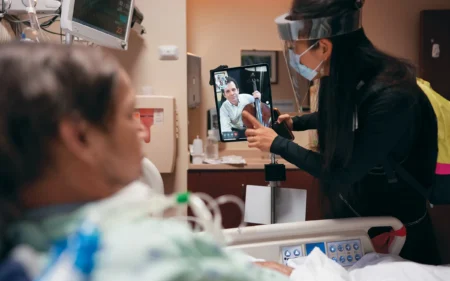
A few of our initiatives serve as a form of action research. The Vital Sounds Initiative (VSI) connects world-class musicians with patients in isolated hospital units through live, one-on-one virtual concerts; the musicians adapt in real time to each patient’s mental state, repertoire preferences, and expressions of grief. Music For The Future brings music composition residencies into correctional facilities where incarcerated participants write original works and hear them performed. The Novel Voices Distance Learning Program extends free virtual instruction and mentorship to under-resourced community music organizations across the world, reaching young musicians in Africa and the Middle East.
Three different programs in three distinct environments, each one geared toward people who are routinely unseen. They share the conviction that attention and attunement can change the quality of a person’s experience when everything around them suggests otherwise. We have watched that conviction prove true again and again, sometimes in the span of a single afternoon.
It was true at Jericho Project, a reentry facility in California, when our musicians and instructor Dana Martin sat down with a man named Reggie. He had arrived three months after losing his infant son, and he would later describe himself, before that week, as someone who had spent his whole life burying what he felt—even writing music without ever really letting himself feel it. After Dana provided the kind of environment where creative, constructive reflection was possible, Reggie discovered a line from Amanda Gorman’s poem “The Hill We Climb” that spoke directly to his own experience of grief and growth, and he began to write.
What emerged was an original composition he titled “Two Sides to One Coin.” By the end of the week, he read his composition aloud to the camera: “What a beautiful struggle. What is beauty without pain? What is ice without flame? In reality, my strongest tears allowed me to overcome my strongest fears. Two sides. One coin.” He called this the first time in his life he had let himself be vulnerable on purpose. No facility budget made room for that moment, and no billing code accounts for it; it happened because a person showed up, created a space for honest reflection, and waited for the real answer to emerge.
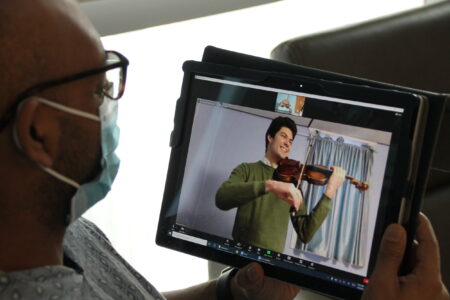
Ten years later, we are still discovering what the decision to be in the room requires from us. Healthcare systems are under extraordinary strain. Staffing is thin. Budgets are depleted. When we bring VSI to a new facility, we are sometimes met with enthusiasm and no resources. Other times, our work is mischaracterized, requiring patient, precise language that explains what we do.
We have learned to read those misalignments carefully and then treat them as learning moments, because they help us map everything an institution has not yet found language for.
Two questions come up most often. The first is whether we are redundant with music therapy, a distinct clinical discipline requiring licensure, diagnosis, and treatment protocols. We are not. Music therapy targets the individual patient through a structured clinical intervention. VSI tends to the whole room: the family member who has been sitting in a chair for six days, the nurse who watched someone unreachable suddenly laugh for the first time in a week.
The second question is operational: what will this cost my staff? The honest answer is—almost nothing. A session requires one on-site person, often a chaplain or patient experience coordinator, a tablet, and a care space. PMHU handles the rest. When administrators ask for clinical outcome data, we explain that we are actively working toward peer-reviewed studies of our own. What we have, for now, is patient testimony, staff observation, and a decade of sessions inside institutions that already had clinical programs and still saw something missing.
The places where music is absent are the places where connection itself has gone thin—the COVID ICU units where VSI first operated, the correctional facilities where no one will ask a person what music they love, the communities where a young musician’s voice is stifled instead of kindled. How we collectively think about the people in those rooms, in those facilities, across those distances, reveals what and who we believe artistic experiences are for, and how far such experiences can take a person.
That question belongs to everyone working in this field. We are glad to be asking it alongside you.
Related Content
Asia, Asia/Oceania, Teaching & Learning, the world ensemble
Developing Teaching Practices from Community Values
Patrick Scafidi

Asia, Asia/Oceania, North America, Teaching & Learning, the world ensemble
International Teaching Artist Conference 2020
Patrick Scafidi
Gather Together, Latin America, North America, the world ensemble
2019 Cohort of Global Leaders Program Gathers in Chile
Patrick Scafidi