

Hosting Fire Up! in Athens: A Week of Collective Practice and Exchange
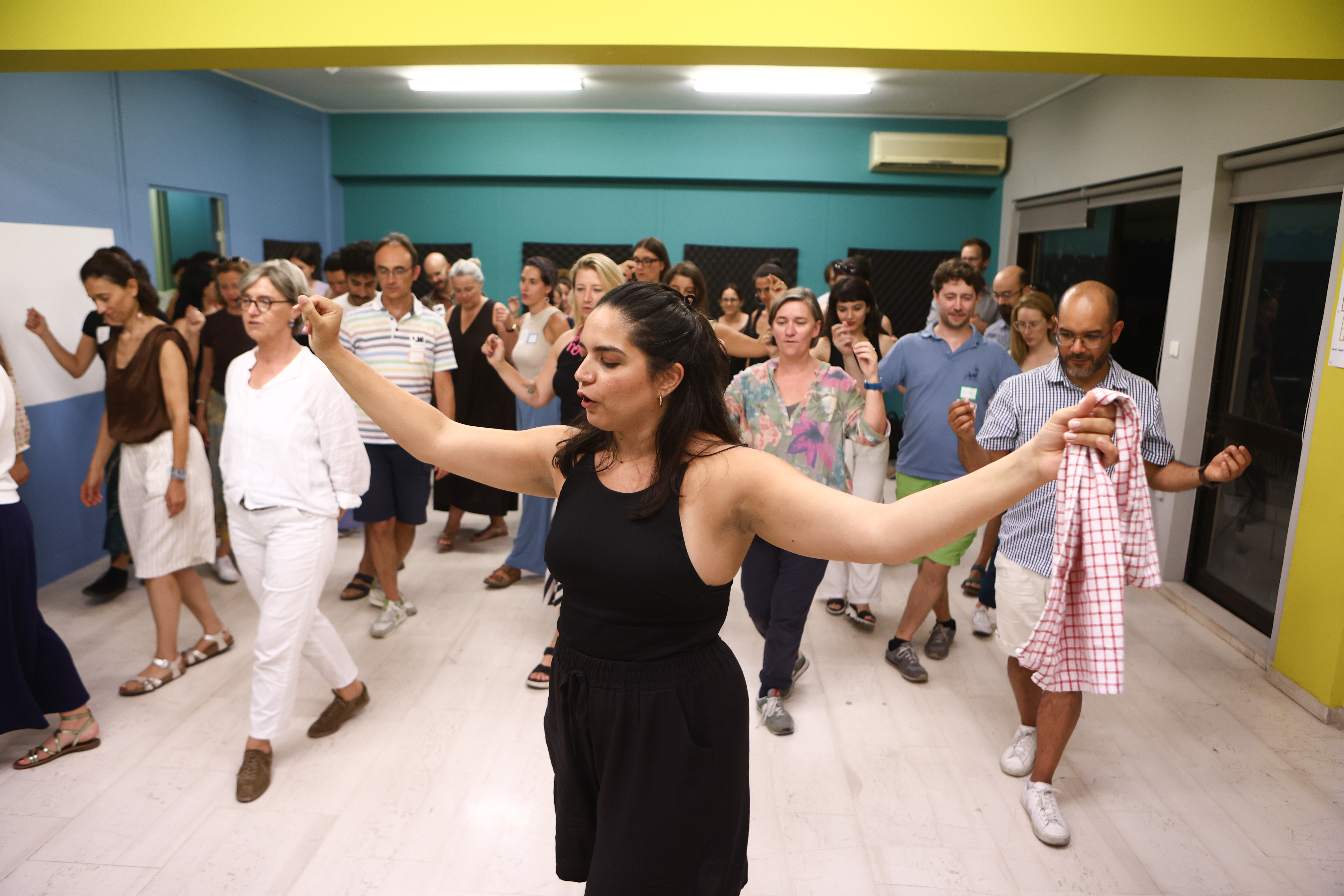
Participants do a traditional Greek folk dance during the Fire Up! residency. Photo: Dimitris Peristeris.
Editor’s Note: Last month, we shared the experience of an attendee of AIM’s Fire Up! Residency. This month, we flip to the other side of that coin by sharing the experience of hosting such a residency. Whether hosted or attended as a guest, these experiences reveal much about our practices and allow us to consider our learning spaces from a different perspective.
When the Academy for Impact through Music (AIM) suggested bringing the Fire Up! residency to Athens, we felt both excitement and a strong sense of responsibility. Our space is deeply meaningful to us; El Sistema Greece is a vibrant community grounded in trust, creativity, and daily collaboration, and inviting colleagues from across Europe into that community felt acutely personal. The residency itself was intense and demanding, with constant transitions between workshops, rehearsals, peer exchanges, and shared experiences. It also afforded us a rare opportunity: a chance to be students in our own teaching spaces, and to see those spaces through the eyes of our peers.
We agreed to host for several reasons. First, we wanted our working teachers to have access to AIM’s training. We also wanted to bring visibility to our programs and, crucially, to our young leaders, who could meet and connect with inspiring professionals from across the continent. By involving more members of the ESG community, we hoped to build a stronger network that would lead to better educational opportunities for our students.
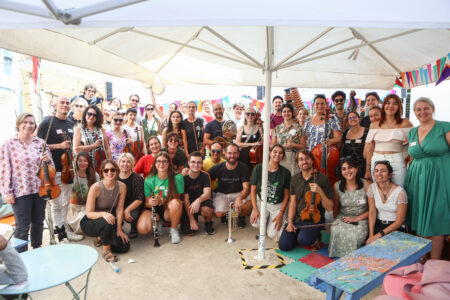
One of our main priorities was to create an environment that felt both well-structured and human. This started in the earliest moments: we greeted participants individually as they arrived, introduced them to the neighborhood of Kypseli, and made sure they felt comfortable in their hotel rooms. The first evening, we organized a night sightseeing tour of Athens that became one of the week’s most memorable experiences, helping participants connect with the city and build relationships in a relaxed setting.
We found ourselves adjusting in real time. The weather was very hot, so we rearranged the schedule and room distribution to make sessions more inviting. We checked in with participants during breaks and stepped back when conversations needed to continue. Shared meals were intentionally unhurried, allowing conversations to build on previous sessions, while coffee breaks became informal opportunities for sparks of connection. We paid close attention to transitions, leaving space between activities rather than moving too quickly from one thing to the next.
But what really stood out about hosting was how it activated our local ecosystem. Partners from our neighborhood stepped in naturally: the NGO Ev Zin supported catering; local cafés and restaurants (many connected to students’ families) welcomed participants; musicians shared elements of Greek musical traditions; a dance teacher introduced traditional dances. Athens International College hosted the group of 60 participants. What could have been a purely logistical effort became a collective process involving the wider community around us.
Still, experiencing a residency as a host is different: you are never fully inside the process, as part of your attention is always on what’s happening behind the scenes. This perspective allows you to observe things as an educator, like how a group cautiously begins opening up, how energy shifts after a shared experience, and how relationships form in the in-between moments.
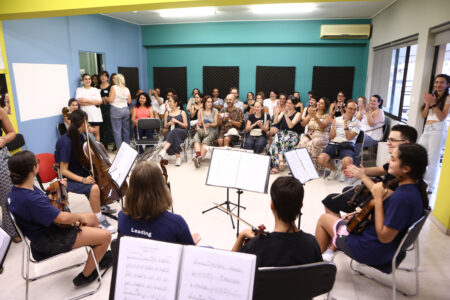
Some moments remain especially vivid. The concert at Victoria Community Center, an open and informal performance with the local community, brought a different dimension to the week’s work, connecting the process to real contexts and people. On the final evening, participants practiced Greek dances in a lively rebetadiko, building on what the Young Leaders had introduced earlier in the week, moving from hesitant steps to a more free and joyful expression. And in a particularly emotional moment, Pooya, a former student now living in Germany, returned to speak about learning music in the Skaramagas Refugee Camp—a powerful communication of our work.
It was also revealing to sit in the student chair in our own space, experiencing AIM’s lessons as our own learners experience ours. Instructions that feel clear when we give them felt open to interpretation when we received them. Moments of waiting, transitioning, or rearranging—things we rarely notice as facilitators—became much more visible. This perspective deepened our understanding of our own practice, reminding us how much learners rely on elements beyond structure, like clarity, rhythm, and emotional cues. It also made us more aware of how a space can be designed to invite participation, allow hesitation, and encourage people to take risks.
The AIM framework is strong, and one of its greatest strengths is how it brings people into dialogue. What feels familiar and intuitive to us is not always perceived the same way by others, revealing both our superpowers and the things we take for granted. As hosts, our role was to make space for this dialogue outside of the classroom—in hallways, over meals, and in unexpected encounters. Those moments make us more responsive educators.
For a few days in September, Athens became a meeting point for ideas, experiences, and people. Our work does not happen in isolation; it grows through relationships, through openness, and through a willingness to share what we have.
Related Content
All Regions, Collaborations, Community Building, Events/Performances, Gather Together, Latin America, News and Resources, North America, Professional Development
New Open-Access Report: “Intercultural Resonances among Music Teachers”
Patrick Scafidi
All Regions, Collaborations, Community Building, Europe, Events/Performances, Gather Together, News and Resources, Professional Development, Research
February 5 Deadline: 12th SIMM-seminar Expressions of Interest
Patrick Scafidi
Ambassadors, Collaborations, Community Building, Featured, Gather Together, Middle East, Perspectives & Collective Action, Student Voice & Leadership, Teaching & Learning, the world ensemble

In Jerusalem, a Space for Healing
Patrick Scafidi
Collaborations, Community Building, Europe, Featured, Gather Together, Student Voice & Leadership, Teaching & Learning, the world ensemble
An International Exchange Program Shifts Power Through Music
Patrick Scafidi


