

Topics
News & Resources
The Importance of Free Play in Music Education
Dr. Richard Marsella, Executive Director, Community Music Schools of Toronto
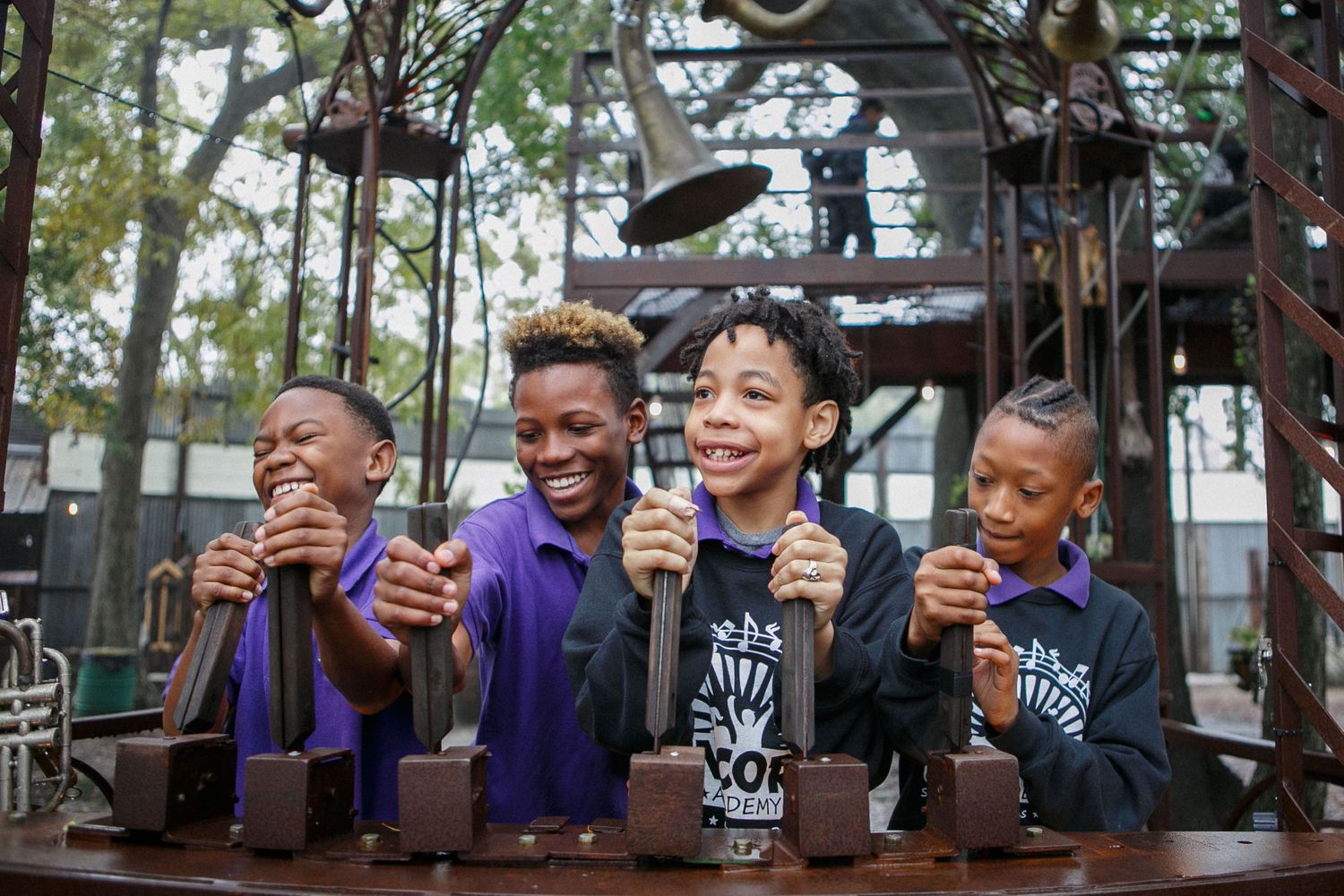
Children playing with new kinds of instruments at the Music Box Village, New Orleans.
During the Covid pandemic, the field of music education across the world pivoted toward virtual learning. Despite the obvious challenges, there was an upside to this: we began to imagine a world more accessible and connected. Students of all ages learned the art of pivoting, wearing multiple hats on multiple platforms, and all at once. We learned how to make art with the technology we had access to, so that relationships between teachers and students could still thrive. We imagined new music rooms, new musical instruments, virtual reality music rooms, musical playgrounds, new outcomes and collaborations.
There were also collaborations within homes, full of self-expression, that it took a pandemic to help incubate. One example sticks with me to this day: a mother reading her poems and editing videos, while her son makes beats and creates the musical backdrop.
As we’ve emerged from this period, I have noticed a strong desire to return to in-person play. Whether in a one-on-one lesson or an ensemble setting, students and parents alike embrace the concept of playing together more strongly than they did before.
In returning to in-person play, let us continue to reimagine what the music room can look like! In some cases, let’s remove the walls. Let’s turn those walls into the instruments themselves. Inside-out is sometimes the best way forward. What else can we do in our music rooms? Who else can come in?
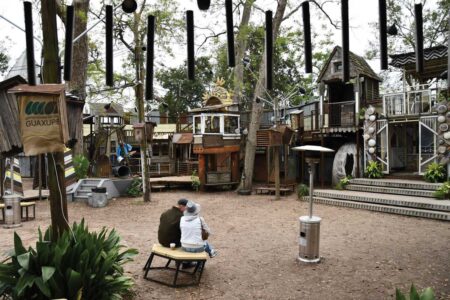
In my doctoral work, I did an instrumental case study of the Music Box Village in New Orleans. This alternative music space wears many hats. It functions as a music venue, learning space, playground, and much more. It includes interactive art installation and instruments made from salvaged materials that form a kind of sonic playground. It’s also widely welcoming: when I was observing grade-four children playing in the space, I noticed that multiple intelligences were accepted and fostered.
Like the Reggio Emilia educational movement that developed in post-World War Two Italy, New Orleans’ Music Box Village arose in response to community trauma—in this case, the devastation of Hurricane Katrina in 2009. The Music Box Village, as an alternative music space, acts as a “third teacher”— simultaneously informing learning outcomes, along with the student and the music teacher.
In pursuing this research, my goal has been to explore a different path for music educators. Why does a musical curriculum need to be so standardized? Who really needs another standard Winter Recital? Let us dream of new musical instruments, projects, collaborations, deliverables, outcomes, and even spaces that have not yet been invented. As formal, publicly funded music programs are being cut from elementary, middle, and high schools, there is a growing need for alternative music education models to fill this gap.
A musical playground can function in any city and will take on a distinct reflection of the city’s sonic and cultural traits. When factors including community health and development, playground design, architecture, and urban planning come into play in the process of planning such a playground, this has the potential to help a neighbourhood heal.
With musical playgrounds, as with the popular “Play Me, I’m Yours” installations of pianos in public spaces, the issue of “noise” inevitably arises. I can certainly think of many less enjoyable urban soundscapes than a musical playground. Still, it’s important for community members to help choose and even shape their own sonic landscapes.
It’s also important for communities to weigh in on questions of playground safety—including the potential danger in removing all risk from play. (Some researchers have found that a certain level of risk in play is actually healthy.) Playground safety is clearly important, but for musical playgrounds we might embrace the simple tenet, as outlined by Schafer (2017), that “art should be dangerous.” In a musical playground, the concept of multiple intelligences can run wild: many kinds of intelligence are fostered among adults and children alike.
As our post-pandemic world collectively begins to reimagine our relationship to spaces, we all have an opportunity to create innovative spaces that build community in bold new ways. For formal learning institutions, this is also an opportunity to rethink established norms and to set up informal learning spaces, because we know that this is where so much of the real learning happens.
Let this grueling transition we’re going through not be in vain, and as we begin to reintegrate as humans, let us all move towards playing more often in communal spaces like the Music Box Village in New Orleans. As a Canadian, I wonder: what city in Canada is daring enough to embrace a musical playground? Of course, we’d do it with our own weirdo Canadian twist on it, celebrating the beautiful and particular assets of our communities.
Dr. Marsella’s recent doctoral dissertation, The Musical Playground as a Vehicle for Community-Building, is available online via the University of Toronto.
Related Content
Community Building, Featured, North America, the ensemble
The Symposium: A Reflection
Patrick Scafidi

Events/Performances, Featured, North America, the ensemble
The El Sistema USA National Symposium
Patrick Scafidi
Africa, Asia, Asia/Oceania, Europe, Latin America, North America, the world ensemble
Save the Date: Make Music Day will be 21 June
Patrick Scafidi


