

Topics
News & Resources
In Their Words: The Flying Carpet Festival’s Sahba Aminikia
Sahba Aminikia, Founder, The Flying Carpet Festival, as told to The Ensemble
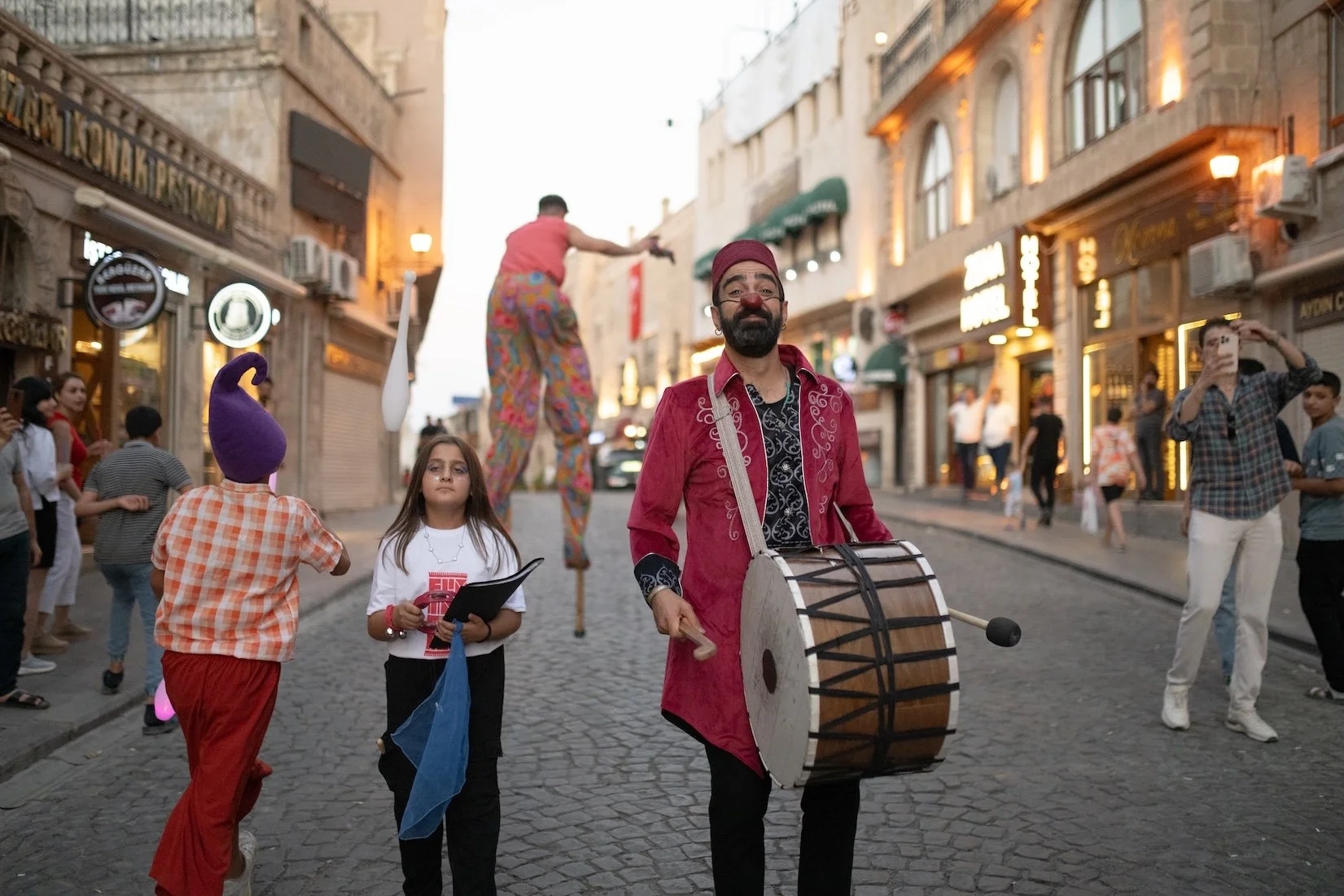
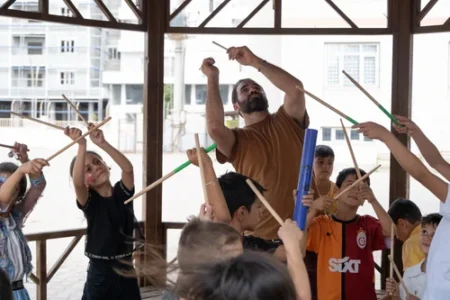
Sahba Aminikia leads the Festival on Day 1, in the city of Mardin, Turkey. Photo: Berna Küpeli.
Late last year, the Flying Carpet Festival was honored with an Aga Khan Music Award, given to organizations that display “exceptional creativity, promise, and enterprise in music performance, creation, education, preservation and revitalisation in societies across the world in which Muslims have a significant presence.” Founded in 2018, the Flying Carpet Festival is a traveling artist residency, or mobile festival, based in southeast Turkey but operating in many of that region’s conflict areas. Having first covered their work last year, The Ensemble recently spoke with Founder Sahba Aminikia about receiving the award, working in areas of conflict and displacement, and how he is learning and growing alongside the program.
—
The Ensemble: Congratulations, Sahba! With the increased spotlight on you and your team, what do you hope is the main surprising thing that people will learn about the region where you operate and its people?
SA: Thank you! We hope people recognize the shift of our cultural needs. It is no longer possible to ignore the vast number of people, especially the younger generation, who lack access to the cultural opportunities that saturate the world’s major capitals. Our work is built on the belief that those living outside centralized power structures have equal claim to the beauty created in this world. Our initiatives are not designed by others but created with host communities, so the final product is always a beautiful discovery for all of us.
You began Flying Carpet in 2018. How has it evolved and changed since you started it?
To me, Flying Carpet is a living entity that learns about the world at its own pace. While it began primarily as a music festival, the 2020 shutdown served as a turning point. We realized the profound power of storytelling, and that artistic experiences should be rooted in stories that resonate across generations and carry the authentic songs of the people.
In our volatile political climate, I’ve come to believe that a festival like this must be more than a performance; it should be a celebration of the inherent beauty in our audience and the children we serve.
Have you noticed a shift in the young people you work with?
Every year. Many of the artists who join us are young people coming from Western societies. When these artists depart, it takes time for them to “return” to themselves—and not the same selves they were before. The project forces a questioning of personal objectives and the meaning of life. Those who return and form our core group are on a path of self-realization. When we meet anywhere else in the world, there is an immediate recognition in our eyes, and we act as family. My favorite comparison is the Heraclea stone, as described in Plato’s Ion: a magnetic force that doesn’t just hold the first ring but transmits its power through a whole chain of rings, binding them all together.
What do you mean when you say that artists must question “the meaning of life?”
By stripping away our expectations, we find freedom. This allows us to treat a child in a remote village with the same respect and radical love we would show an audience in a Western capital.
To be truly free, you must get rid of the extras. We perform without electricity, water, and other amenities, and become lighter, smarter, more impactful, and less possessive people. It’s magical.
Is that why Flying Carpet was designed as a mobile festival?
Yes. Traditional cultural venues are often in privileged locations and, more often than not, they are empty. Mobility allows us to be anywhere at any time. We have performed in funeral houses, in tiny 40-square-meter rooms, in parks, in the middle of an alley and in the middle of the desert.
What have you learned in that time?
Operating in a region marked by ethnic and religious tension means we are constantly navigating a history of violence, a reality that shapes the society we must learn to collaborate with and love.
The most important lesson I’ve learned is to maintain a cycle of growth: imagine, plan, implement, evaluate, and grow. Our true breakthrough has happened through listening. The more I spoke with participating children, the more real the project became. The logic of children is impenetrable to the cynicism of the adult world; their philosophy is truly a divine way of looking at our world.
Do you have ideas about what comes next for Flying Carpet? Is there a new benchmark you’d like to hit?
Flying Carpet will always look toward the village. I hope we can replicate our model in Iran, Syria, Egypt, Palestine, and other countries in the region—places where all children can enjoy this celebration of color and life.
The project must always remain a labor of love. Otherwise, we risk becoming an NGO that lacks the personal touch required for us to have success.
What is your biggest takeaway after growing Flying Carpet over the past decade?
Only love, a radical belief in hope, and a total commitment with no expectation of return can enable us to do extraordinary things. And, above all, we should never do them alone.
Related Content
Collaborations, Community Building, Europe, Featured, Gather Together, Greece, Program Design, Teaching & Learning
Concerts for Babies Transform Stages Into Communities
Patrick Scafidi
Africa, Community Building, Featured, Program Design, Teaching & Learning, Uganda
In Uganda, Music Unearths the Questions That Heal Us
Patrick Scafidi
All Regions, Collaborations, Community Building, Events/Performances, Gather Together, News and Resources, Professional Development
One-Day Choirs
Patrick Scafidi
All Regions, Collaborations, Community Building, Events/Performances, Gather Together, News and Resources, North America, Professional Development
Leadership Development Program at Sphinx
Patrick Scafidi


