

GUEST PERSPECTIVE
Why Willing Volunteers Still Don’t Show Up: How youth music programs can turn goodwill into support
Last month, my daughter’s choir director needed parents to take tickets to the year-end concert. I had been a choir singer and director myself, so I know the invisible work it takes to put students on a stage. When the request came, I wanted to be the kind of parent who shows up.
Then, my week got overwhelming. By the time the concert arrived, I was no longer deciding between helping and not helping. I was deciding which responsibility would boil over first if I took my attention off of it.
I checked the sign-up list. Seven other people had volunteered. At that moment, the decision made itself: they didn’t really need me. Other people would show up.
The easy interpretation would be that I didn’t care enough. But that wasn’t true. My intent had not changed. The practical equation had: Would my absence create a problem? Could I step back without hurting the outcome? Once I believed the answer to that last question was yes, my caring stayed intact but my participation disappeared.
For youth music programs, this kind of calculation matters. Many programs are surrounded by a relatively untapped circle of people who wish them well: parents, alumni, neighbors, audience members, board friends, local artists, retired educators, and community members who believe in what music can make possible for young people. And many people in those circles would be eager and willing to contribute volunteer time and energy, if they think it would truly help.
But the ask has to be clear. Volunteer participation usually breaks down in the space between willingness and clarity. People may believe in the work and want the outcome to succeed. What they do not always see is whether a request is meant for them, what action is being asked, why the action matters, or how to take the next step.
That gap is why I designed RAMP, a simple process that helps organizations clarify role, action, meaning, and pathway. RAMP refers to four basic elements people need to understand, in order to be able to take steps toward volunteer involvement. Programs need to make sure they provide clarity in these four areas.
“Role” asks whether people understand where they fit. “Volunteer at the concert” is a broad category. “Take tickets at the front table” is a role.
“Action” asks whether the next step is specific enough to take. “Help with the concert” is easy to support but also easy to postpone. “Arrive at 5:30, take tickets from 6:00 to 6:45, and check in with Maria at the front table” gives people who care something concrete to do.
“Meaning” asks whether people understand why their action matters. A ticket table is not only a ticket table. It frees staff to stay with students. It helps families enter calmly, and welcomes them. It protects the tone of the event before the first note is played.
“Pathway” asks whether the next step is easy to find. Even people willing to expand their volunteer activity lose momentum when they have to search through old emails, ask three people, or wonder whether the sign-up link is current.
Looking back at my own “volunteer or not?” decision, I realize that the sign-up list gave me information, but it did not give me meaning. It told me seven people had signed up, but it did not tell me whether the need was actually covered, what role still mattered, or what would be the benefits, for the kids involved, of one more adult showing up.
A clearer request might have changed the equation for me. For example: “You may see several names on the sign-up list, but we still need two adults at the ticket table from 6:00 to 6:45 so families can move through quickly and staff can stay focused on students. Check in with Maria at the front table, and you’ll be finished before the music begins.”
That kind of request does more than fill a slot. It helps people interpret the need.
When youth music programs clarify role, action, meaning, and pathway for potential volunteers, they reduce the guessing required. People are more likely to commit and follow through when they can recognize the specific need their participation will meet.
Adopting a RAMP approach does not mean every person will say yes. Some people truly do not have the time, capacity, transportation, childcare, or flexibility to volunteer. Many parents and community members are already doing as much as they can.
But clearer volunteer pathways honor both realities: the limits people carry and the willingness—even eagerness—they may feel, to help a program they care about.
Volunteer participation will always involve friction, because people’s lives are full. But friction is not the same as unwillingness. A person who does not respond to a broad invitation may still respond to a clear one. A person who assumes others have it covered may step forward when the need is visible.
People who care are often closer to participation than they appear. The work is making the need clear enough that they can recognize the moment when their small “yes” matters.
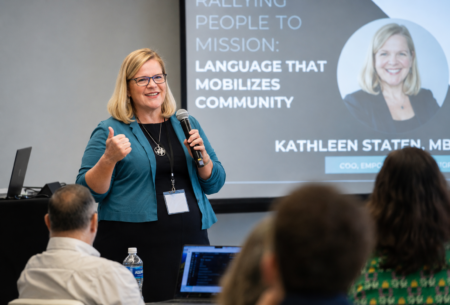
Kathleen Staten brings a background in music, education, and strategy to her work with mission-driven organizations through her company, Your MBA Friend Consulting.
Related Content
News and Resources, Professional Development, the ensemble
News Notes, December 2020
Patrick Scafidi

Community Building, Featured, Gather Together, North America, Program Design, Student Voice & Leadership, Teaching & Learning, the ensemble
Sistema as School: WHIN’s Ways of Being
Charles Ortiz
Featured, North America, Opinion, Program Design, Teaching & Learning, the ensemble
Teaching Habits of Mind
Lorrie Murray
North America, Program Design, the world ensemble
BLUME Haiti: Building Leaders Using Music Education in Haiti
Patrick Scafidi


