
From Spark to Flame: A Glance at Fire Up! 2025
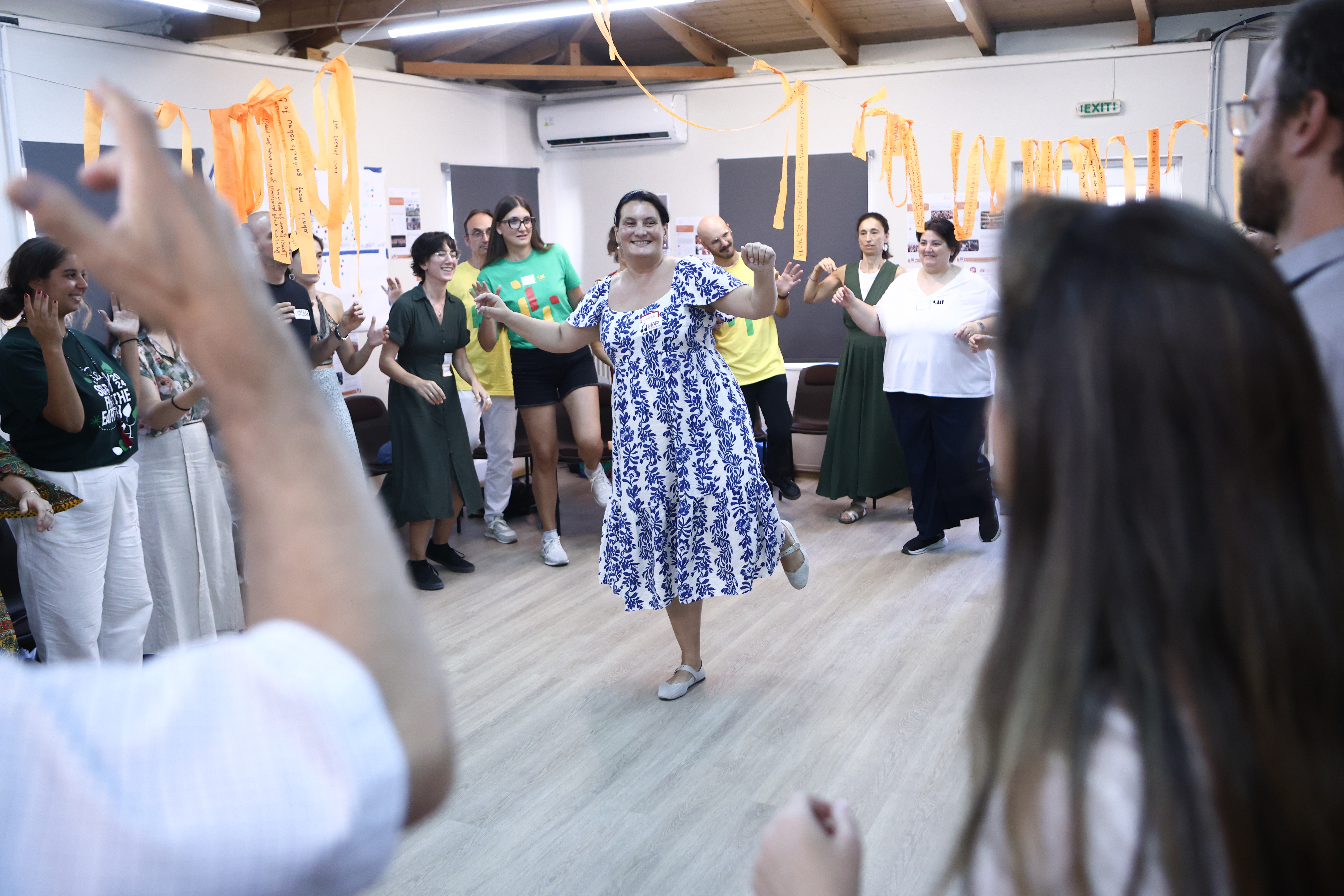
A Fire Up! cohort member leads the group in a movement activity: learning a Serbian folk dance.
Imagine choosing—on purpose—to stop. To give yourself a moment of attention and ask, without judgment, a simple question: “Why do I do this work?” It’s a small exercise of meditation and self-awareness that we rarely find time for in our noisy daily routine. And yet, in that brief pause, something can appear: a spark that feeds the question, gives it space, and makes it louder.
For me, Fire Up! 2025 in Athens—a four-day teaching artist residency led by the Academy for Impact through Music (AIM)—was that spark.
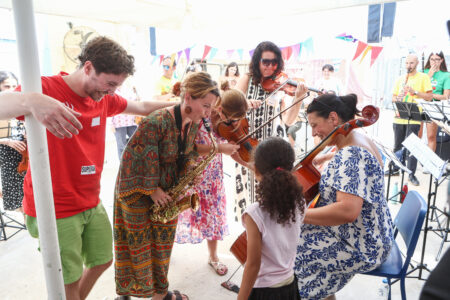
Playful and methodical at once, the residency featured hypothesis trackers, rapid polls, icebreakers, speed-talking sessions, unexpected, sometimes bizarre hunches leading to new breakthroughs, a few moments of crisis, and joyful, sometimes spontaneous ensemble music-making—four intense days that, months later, still influence how I look at my work. But let me step back.
For many years I have worked as a wordsmith for SONG – Sistema Lombardia in Italy while also collaborating with the Sistema Europe network. When I heard about the Fire Up! Residency, I signed up almost instinctively, joining a diverse cohort of teaching artists and program leaders from across Europe, each with their own challenges and united more by questions than by answers.
That first day, the atmosphere wavered between curiosity and disorientation. We were being hosted by our friends at El Sistema Greece, where we met in a simple space, far from traditional formats of front-facing conferences and workshops. Before we even began, the walls were speaking: data, charts whose purpose we didn’t yet understand, and intriguing words like “agency” and “metacognition”—terms I would only grasp days, sometimes weeks later.
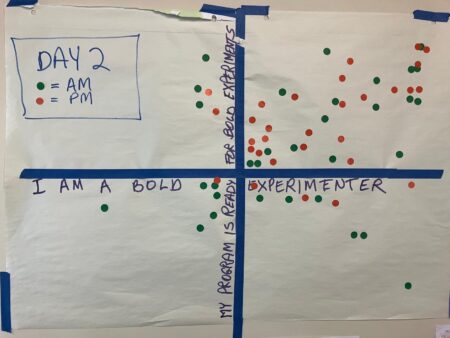
It was clear right away that we were not there to “learn a model” and apply it in a single, uniform way. We were there to approach a learning philosophy that felt both scientific and human, something we could challenge, interpret, adapt, and tailor to our own organizations. Groups were tasked with creating their own action research, a concrete experimentation plan we would implement after returning home. No one had a precise map, which only made the experience more powerful. We laid out the path together.
In this constant flicker of ideas and hypotheses, community work was pivotal. A strong, palpable bond was forged, generating mutual understanding, fertile debate, and continuous shifts in perspective. Not every day was easy. At times I felt confused, lost. I wondered what I was doing there. My head felt like a ringing bell, thoughts echoing into a single, indistinguishable clang. I found myself missing my SONG colleagues, without whom my Action Research ideas felt amorphous and uncertain.
But slowly, almost without noticing, I came to understand that it was not the time to tidy up my thinking but to swim in a spring of ideas and questions. I couldn’t stay comfortably inside my certainties because someone with a different viewpoint would inevitably challenge them. Some conversations shook me deeply. One day, during a discussion on how our performance structures might give students more agency, one participant cut in: “What happens to all our ideas when a child walks in carrying a difficult day or a difficult life?” That simple, burning question led me to reconsider something I had previously taken for granted: the true purpose of a socio-cultural organization. Before music education can happen, we must build a safe space for trust and emotional regulation—the human foundations that make learning possible.
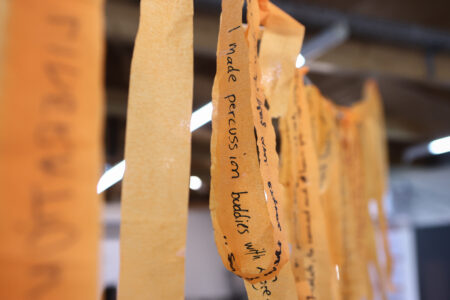
Hour by hour, doubt by doubt, guided with kindness and precision by the AIM faculty, we shaped the first sketches of our action research. At SONG, ours was called “The Cascading Effect.” Grounded in the conviction that we only transmit what we receive, it centers on fostering a more deliberate relationship between administrative staff and teachers, enabling players to experiment within an open musical framework and use their own ideas to create a unique concert setting. We started with teachers, setting up a staff Shared Think Tank (monthly conversations supported by a virtual board) to map needs and select small tests, and paired it with a student creativity routine—Wish Ribbons and improvisation within a score-based warm-up. We were trying to build a repeatable and tangible pathway for agency and creativity: teacher intention becomes more visible in daily practice, students recognize it, and participation begins to escalate, rehearsal after rehearsal.
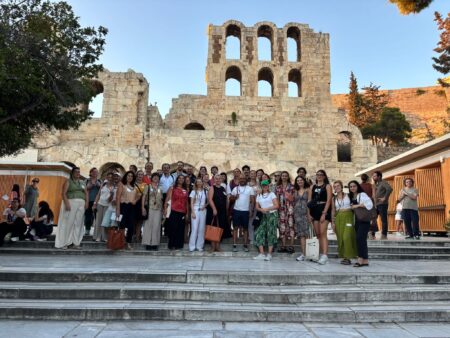
Months later, I find myself at my desk having just presented our Action Research project, and feel a new clarity. For those in our field, it is healthy to engage with thoughts that exist in perpetual motion. When we become comfortable with those thoughts, they push our ideas forward once we seem them through. The ideas that guide our work complete their own life cycle—pushing forward into new ones once they’re complete.
With their permission, I want to close with a reflection from our friends from LiberaMusica at the end of their Action Research presentation:
“Teaching is not improvisation, it’s impact engineering. If we want music to be a real right, our work with young people must be planned with the same rigor we expect from performance: clear goals, measurable steps, documented progress, and constant refinement based on evidence. A more scientific and sharper program is not bureaucracy; it’s an act of care and fairness.”
Related Content
Europe, Gather Together, the world ensemble
Side by Side by El Sistema Sweden: Impressions from a Participating Program Director
Patrick Scafidi

Gather Together, Latin America, the world ensemble
Teach a Man to Fish: Sonidos de la Tierra and the Power of Community Autonomy
Patrick Scafidi
Featured, Gather Together, North America, the ensemble
Changing Lives; Changing Interlochen
Patrick Scafidi