

EDITORIAL
Snapshots of the Work Tell the Story of Our Impact
For programs dedicated to music for social change, it’s sometimes difficult to convey what true impact should look like.
Do you measure the number of young people who walk through your doors? Do you focus on their musical proficiency in playing the great western classical compositions of our time? Do you measure exclusively in social outcomes, like how your young people thrive beyond their music lessons?
When I think about my own program, YOLA, I lean into a simple method of macro-reflection: What have we been able to influence in the lives of our young people and communities?
Every other week this season, I wrote updates to my Los Angeles Philharmonic colleagues—small, internal notes meant to keep our broader institution abreast of what the Learning Department was up to. On the surface, these could be viewed as mundane: a calendar snapshot, a few highlights, the ever-important statistics everyone needs. But in scrolling back through nine months of messages, I’ve realized the depth they carry. These were not only stories about music lessons, concerts, and special events. They were testaments to the impact of connection built across programs, networks, and industries.
In making these connections, it’s been helpful to center the artistry of our young players. Last summer, for the first time, 17 YOLA musicians performed side by side with the L.A. Phil at Walt Disney Concert Hall. In the final celebratory moments of the concert, a confetti of polaroids of Gustavo Dudamel’s 17-year legacy sprinkled from the hall’s boat-like ceiling, each photo celebrating his commitment to supporting the next generation.
We’ve also made connections between musical genres. In October, we hosted a community celebration at our Inglewood facility, the Beckmen YOLA Center (BYC). Gracias, Gustavo! welcomed thousands of community members to hear and celebrate our young musicians and featured an important conversation between renowned rapper D-Smoke and Gustavo—two artists, two worlds, with a shared passion for music education. We closed the day featuring both our YOLA Institute Orchestra and our inaugural YOLA Big Band, led by lauded jazz musician and YOLA Teaching Artist Poncho Williams.
Our center, used for music learning six days a week, doubles as an active community resource. In November, the BYC turned into a donation site for neighbors impacted by the L.A. wildfires, collecting non-perishable goods for five weeks in partnership with the Social Justice Learning Institute. In the winter, we hosted a community listening session for the California Community Foundation, helping this major funder hear directly from local leaders about what their neighborhoods need. In the spring, we became a venue for the Department of Children and Family Services’ foster-parent appreciation event, and also a host for the county’s monthly Racial Justice Learning Exchange, where our young percussionists performed alongside musicians from another El Sistema-inspired program while participants learned traditional Filipino bamboo dance.
None of those events were, strictly speaking, music lessons. But all of them were The Work. Each made the same quiet claim: that an orchestra’s building can be civic infrastructure, and that a youth music program earns its place in a community by being useful to that community.
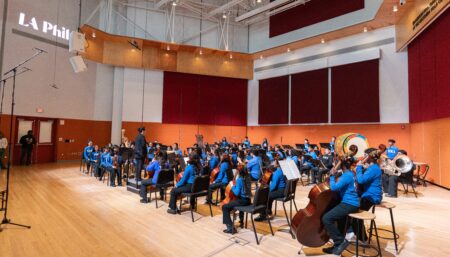
Sometimes, that means paving roads that lead toward us. A partnership with LA County Parks and Recreation sent teaching artists into parks across all five county supervisorial districts, bringing music to roughly 200 children in free after-school settings—a deliberate front door into our hubs. We also partnered with another peer organization, Education Through Music, to host professional development at the BYC, opening training to over one hundred music teachers from across L.A. County.
Other times, we pave roads leading away. This year, 52 percent of our graduating class decided they would embark on our Music Pathways journey. (When one of our oboists received an underwhelming scholarship offer from a top conservatory, a member of our team helped her appeal it, more than doubling her financial aid.) Today, more than half of our alumni are now active in the creative industry, whether performing, studying, or advocating for the arts in civic life.
It bears mentioning that, as a program of the LA Phil, YOLA has a unique agency to create these networks. We operate in a city that is the cradle of the entertainment industry, and with the support of one of the most well-resourced orchestras in the world. Sometimes that access comes with the complication of competing agendas, where competition for attention can feel akin to shouting into a void. Still, our focus on cross-sector collaboration has built clear tracks we can follow. Whether you are a large, well-resourced program or one with fewer resources, leveraging your community impact requires the same amount of commitment to relationship-building, reflection, and healthy organizational priorities.
This practice of macro-reflection leads me to one succinct recommendation (and some words of encouragement): measure your program by what happens both inside and outside its four walls with equal tenacity. High impact is not a function of how much a program does. It is a function of how well a program connects—how completely it weaves itself into the life of a community and the lives of its young people, and how long it is willing to stay there. The work of our field is not just to build the best program in the room. It is to make sure no child is ever in the room alone.
Related Content
Events/Performances, Gather Together, Latin America, Performance, the world ensemble
Medellín welcomes Composer Arturo Márquez
Patrick Scafidi

Boston, Funding & Support, Gather Together, North America, Professional Development, Teaching & Learning, the ensemble
Massachusetts Cultural Council META Fellowship
Patrick Scafidi

Asia, Events/Performances, Gather Together, Performance, Professional Development, Teaching & Learning, the world ensemble
Around the Sistema World with Hannah, Part Six: Philippines
Patrick Scafidi
Gather Together, Latin America, Performance, the world ensemble
Batuta Students Perform in Music Festivals Around the World
Patrick Scafidi


