

An International Exchange Program Shifts Power Through Music
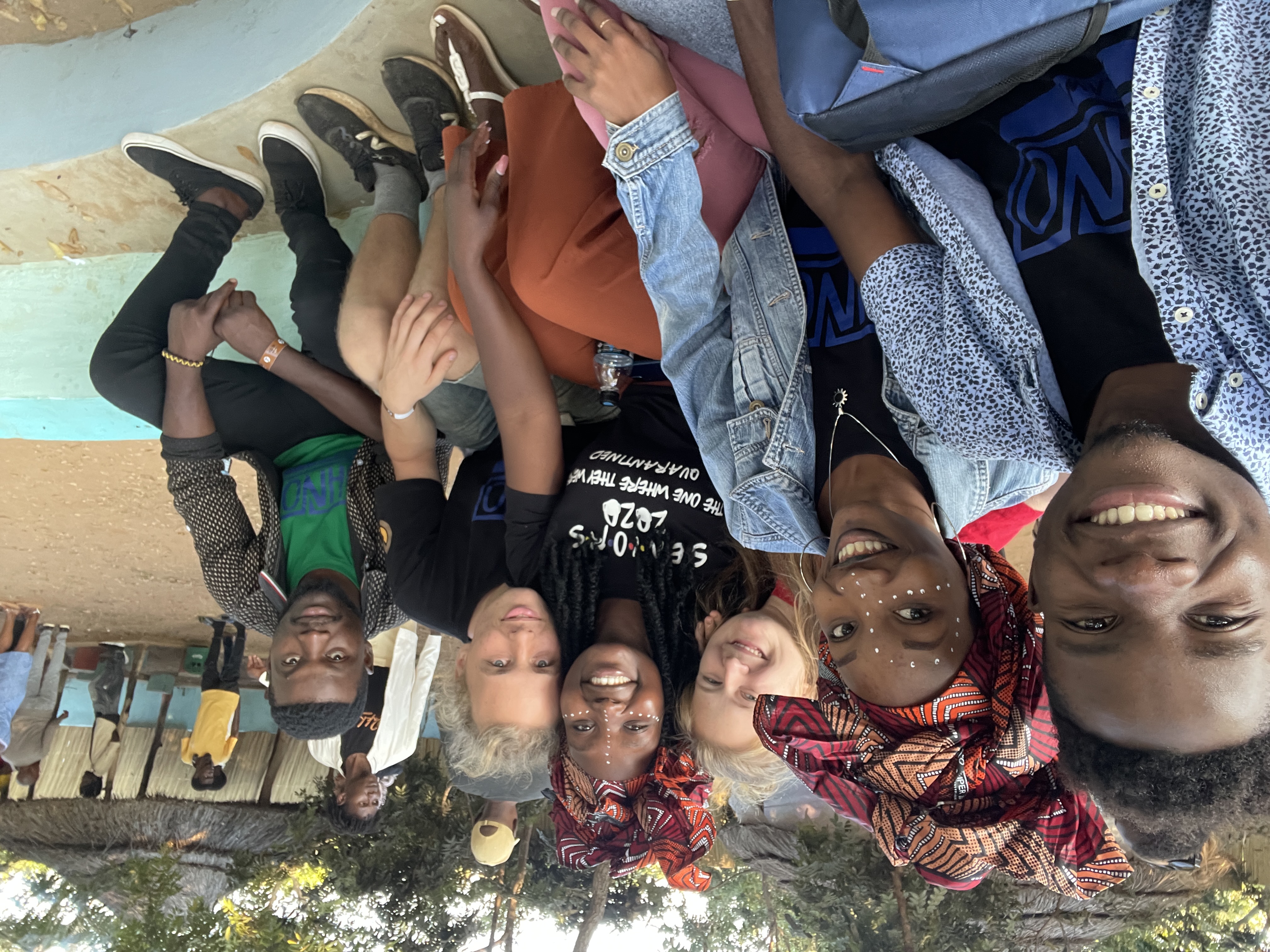
MOVErs together in Malawi. Photo: Frøya Carlsen.
While our daily lives are rattled by increasing global instability, polarization, and apathy, culture workers working toward youth empowerment and social change share many of the same questions. How do we empower young people without transferring unreasonable responsibility? How do we equip and motivate while acknowledging legitimate, sometimes harsh realities? How do we facilitate interconnectedness, in times of global dehumanization?
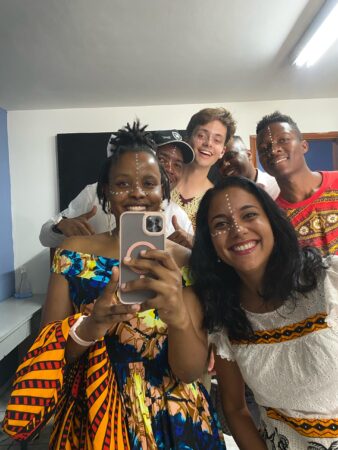
For Jeunesses Musicales Norway, part of our answer is the Musicians and Organizers Volunteer Exchange (MOVE), which brings together musicians aged 18-25 for nearly yearlong work exchanges. Volunteer participants from three leading music organizations within the JM International network—Sustenidos in Brazil, Music Crossroads in Malawi, and JM Norway/Trondheim Municipality in Norway—exchange places for ten months. The program is centered around intercultural musical collaboration, leadership development, and community music activities.
Our goal is both simple and complex: to give young musicians practical insight into how music and culture can shift power, challenge inequitable norms, and strengthen communities. With the guidance of their host organizations, participants practice the many ways music can function in a community—by teaching, performing, organizing events, and taking part in local cultural activities. Gradually, the familiar role of musical performer merges with new insight into community music-making and social change-making.
Our approach to music for social change is shaped by the conviction that how you do something is a crucial point of entry, rather than merely what you do. Our young emerging leaders have already had valuable experiences in “the what” of many kinds of musical experiences—for example, musical expression, teaching settings, and cultural events. In their new learning contexts, far away from what’s familiar, we aim to nudge their gaze towards “the how,” through a loosely assembled toolkit of principles and methods.
Practicing LOUD Principles for Change
One foundational building block in the toolkit is the LOUD pedagogy, which emphasizes thinking outside existing norms and creating new ones. Developed at the first LOUD! girls’ band camps in Norway, this pedagogical approach emphasizes participation, expression, and inclusivity—for diverse groups in general, and especially for those rendered marginalized. Leading principles for learning steer the practice, like “Learning by Doing,” which stimulates diving in rather than overthinking, with activities designed to require as little planning as possible. “Do It Together” reinforces this by providing low-stakes ways to practice cooperation through games, group agreements, and shared obstacles. The Bumblebee Effect posits that challenges are the most natural thing in the world, provides games and tools to apply this idea, and builds confidence.
Principles like these are often a breath of fresh air compared with formal music education and pedagogy. By strengthening the participants’ relationship to ‘the how’, they encourage experimentation and critical reflection.
Un ejemplo
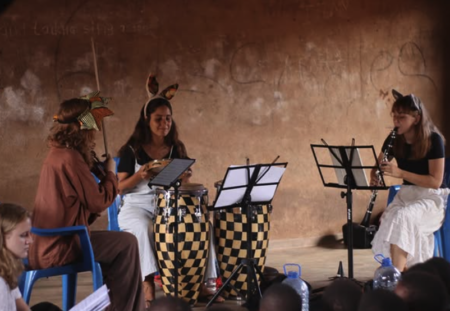
When Norwegian teaching artists Ester, Anna, and Gunhild, and Brazilian teaching artist Victoria worked in Lilongwe, Malawi for ten months, they learned about the Malawian Folklore Project, a local initiative to document traditional folktales and folk songs.
Inspired by this material and her new musical impulses, Ester composed a children’s musical play based on the folktale “Kalulu the Hare’s Tricks,” while her fellow participants were engaged as musicians, storytellers, and actors. The team were responsible for everything from making costumes to the planning, development, and pedagogy of the performances at local primary schools in Malawi—and, in 2026, also in Norway.
Thus, they were able to contribute both to the safeguarding of traditional cultural expression and to expanding their communities’ access to international music and culture—two of the main goals for the MOVE project. Through the “Kalulu the Hare” project, Norwegian, Brazilian, and Malawian musical expression merged to create a synergy of sound and creativity.
Space to Grow into Leaders of Tomorrow
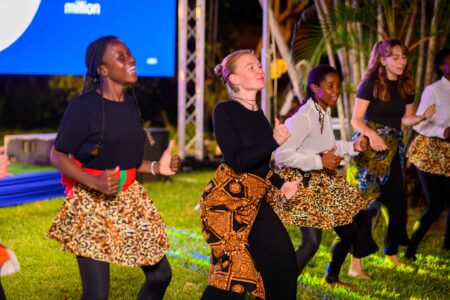
The format of a lengthy international exchange program provides important lessons in turning challenge into growth and opportunity—a much-needed skill during the times we live in. Participants arrive with different musical backgrounds, different assumptions about leadership, and different comfort levels with unfamiliar roles. They experience cultural misunderstandings, become aware of their own preconceived notions, and learn to collaborate rather than to instruct or help. Empowered by a greater insight of ‘the how’ in their work, they become more resourceful cultural leaders, better equipped to tackle the unknown.
Even after 14 years, each MOVE cohort teaches us something new. However, one lesson endures: young musicians don’t need us to hand them a blueprint for social change. They need space and empowering tools to practice, make mistakes, and discover their paths to leadership and change making. Hopefully, they become better equipped to sustain lifelong engagement in the world of music and social change.
Contenido relacionado
Collaborations, Community Building, Europe, Featured, Gather Together, Greece, Program Design, Teaching & Learning
Concerts for Babies Transform Stages Into Communities
Patrick Scafidi
Africa, Community Building, Featured, Program Design, Teaching & Learning, Uganda
In Uganda, Music Unearths the Questions That Heal Us
Patrick Scafidi
All Regions, Collaborations, Community Building, Events/Performances, Gather Together, News and Resources, Professional Development
One-Day Choirs
Patrick Scafidi
All Regions, Collaborations, Community Building, Events/Performances, Gather Together, News and Resources, North America, Professional Development
Leadership Development Program at Sphinx
Patrick Scafidi


