

Topics
News & Resources
In Gaza, Children Sing with Drones
Ahmed Abu Amsha, Founder, Gaza Birds Singing; musician, singer, composer, sound engineer, music teacher, and manager of music education programs in Gaza, as told to Ensemble editor Tricia Tunstall
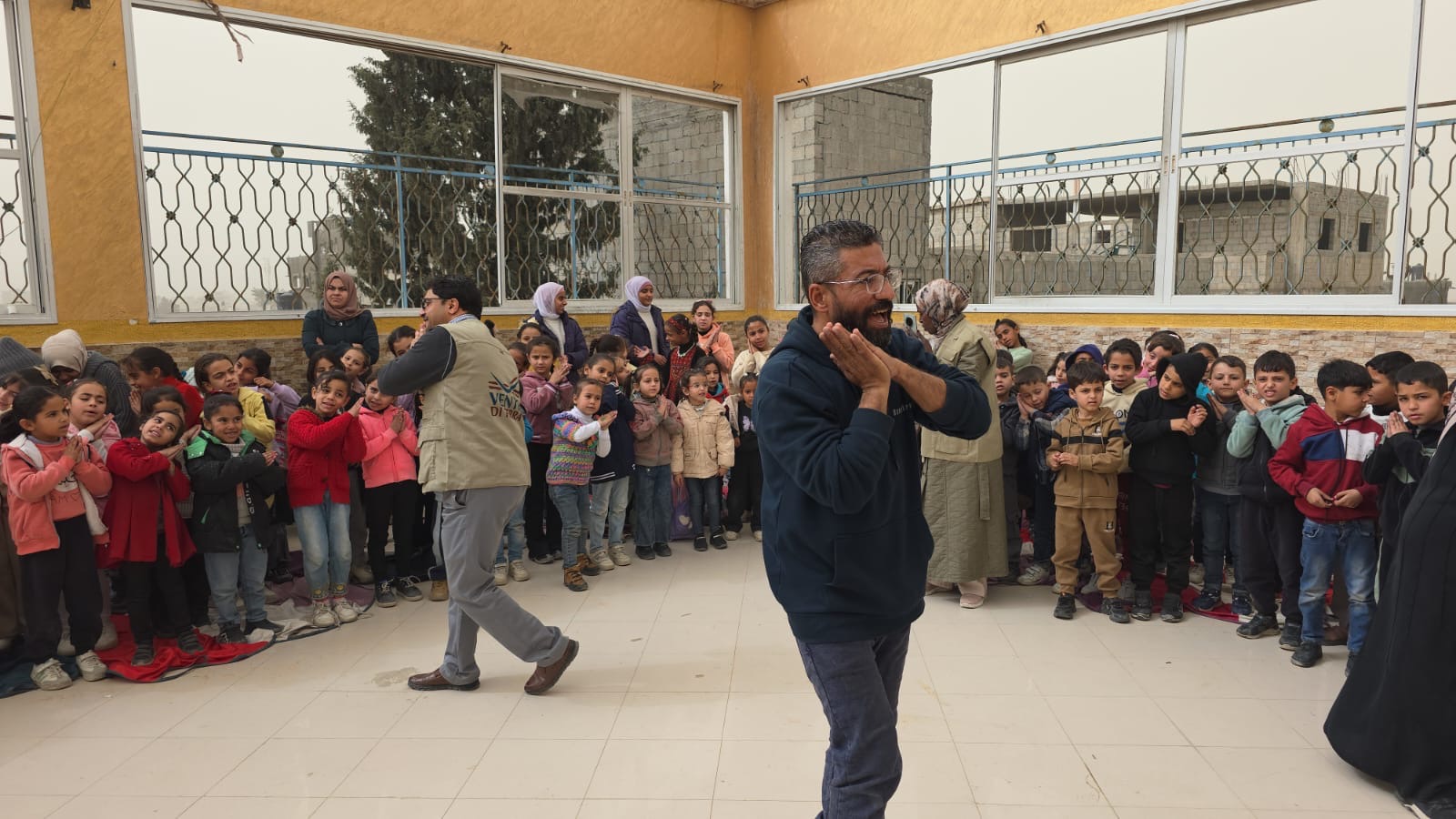
Ahmed singing with young children.
In the beginning of the war on Gaza, I was displaced from my town of Beit Hanoun at 3 a.m. We were running, without shoes, without anything. We arrived in Jabalia, near Gaza City. I was not thinking about music; I was just running for a safe place.
In August 2025, when Gaza City was under heavy bombardment, I was in the Al-Rimal area, trying to do some singing sessions with a group of kids. There were a lot of drones in the sky; the sound was annoying and very loud. We couldn’t hear each other. The kids had headaches. They said, “Hey, we have to stop, we can’t hear you.” But I knew that even if they went to their tents, they would still be hearing the sound. So I said, “No, nobody’s going to stop us from singing. Imagine this drone is our background music and sing with that sound.” I started singing the first song that came to mind: “Sheel Sheel Ya Ajmal Sheel..” (“Carry on, camel driver…”) And we tried it, and it worked. I made a video and posted it, and it went viral.
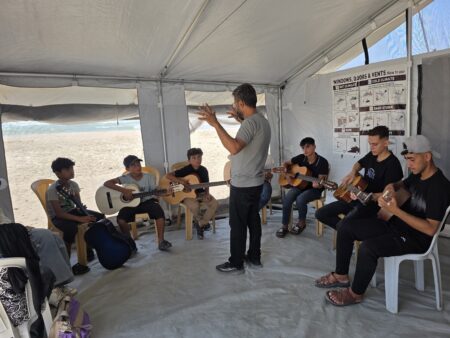
I began to see that this was a beautiful idea. Kids were waiting for the drone, to sing with it. They weren’t afraid of that sound, anymore; to them, it meant singing. “Hey, I’m waiting for the drone and it’s not coming…now it’s coming! Let’s sing with it.”
Over the course of the next six months, I was displaced 15 times. Eventually, I arrived in Rafah, in the musicians’ shelter. Some of my friends brought me a guitar and asked me to play. I had not held an instrument for six months…when I first held the guitar, it was a kind of shock. I started to play. And then all the kids came running around me, singing together. In those minutes, I forgot what I had been going though; I felt good. And the kids were very happy.
So it occurred to me: let’s make a music session every day. It’s a healing thing. I can heal myself and heal these kids, and we can forget what we are suffering. Quickly, our group of kids became bigger. And I started going to the other camps around us, to bring music to those kids.
But it wasn’t long before we received a message to evacuate Rafah. So we went to Khan Yunis, in the desert, and there were a whole lot of people—a lot of camps. I went looking for talented kids. And I found so many! I told the managers of the camps that I wanted to do an activity. “What kind of activity?” they asked.
I said, “Music!” And at first, they laughed at me. “Can’t you see, all the tents are full? And anyway, what can music do?”
“It’s going to change the kids,” I told them. “It’s going to heal them.”
And then they said, “Yes, we’re behind you. Go for it.”
I knew that many of my colleagues from Edward Said Conservatory were in the area, so I went to them and said, “Hey, I want to make a music activity for the kids.” They were worried that it was dangerous; there was bombing everywhere. But they agreed.
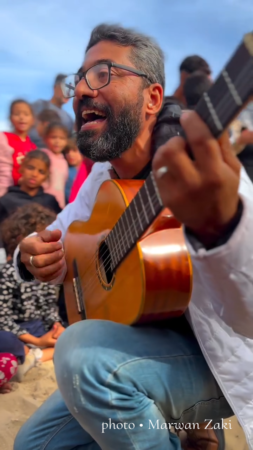
So we made a group of kids there. There were no instruments. I tried to find some, but people were using guitars as firewood. I told everyone, “Please, if you have any wooden instrument, just keep it.” I found a broken one and fixed it with glue, and I used bicycle wire to make strings. And we found a water pipe and made holes with it; that was our flute.
There was never enough space in Khan Yunis. And it was full of people. At one point, there were a million and a half displaced people in the Al-Mawasi district (an area that had a prewar population of 9,000). So I made my tent very small; that way, I could create some space for the kids’ music. I couldn’t buy another tent to put in that space (tents were very expensive) so I brought some carpets to cover the space from the sun.
That’s where the music happens. We decided to call ourselves “Gaza Birds Singing.”
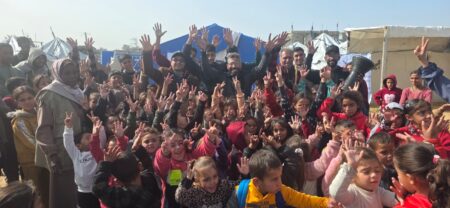
So that’s where the story of Gaza Birds Singing begins, there in Khan Yunis. We had a lot of stories to tell—a lot of sad stories, a lot of good stories. After a while, we posted a few songs of Gaza Birds Singing. The videos went viral. And I think—I hope—that our message got delivered to the world: we are innocent people, we are musicians singing about love, about life. And we love peace.
We teach the kids traditional songs—mostly about peace and joy. We compose some songs, too…about love, about peace, about the situation we’re living in.
The idea is simple: try to make something bad into something good.
In this work, I’ve learned that nothing’s impossible. If you want to do something in any circumstances, you can do it. The beautiful thing that can help people and heal people—it will make you happy, too. Happy to help your community, your people. And you can heal yourself. You can heal.
Related Content
Gather Together, Latin America, the world ensemble
Teach a Man to Fish: Sonidos de la Tierra and the Power of Community Autonomy
Patrick Scafidi

Featured, Gather Together, North America, the ensemble
Changing Lives; Changing Interlochen
Patrick Scafidi

Latin America, North America, Teaching & Learning, the world ensemble
Announcing the launch of Music In Action Journal: A Knowledge Hub for the Frontlines of Music-For-Social-Action
Patrick Scafidi


