

Fifteen Years After Disaster, a Children’s Music Festival Continues to Rebuild Community in Soma, Japan
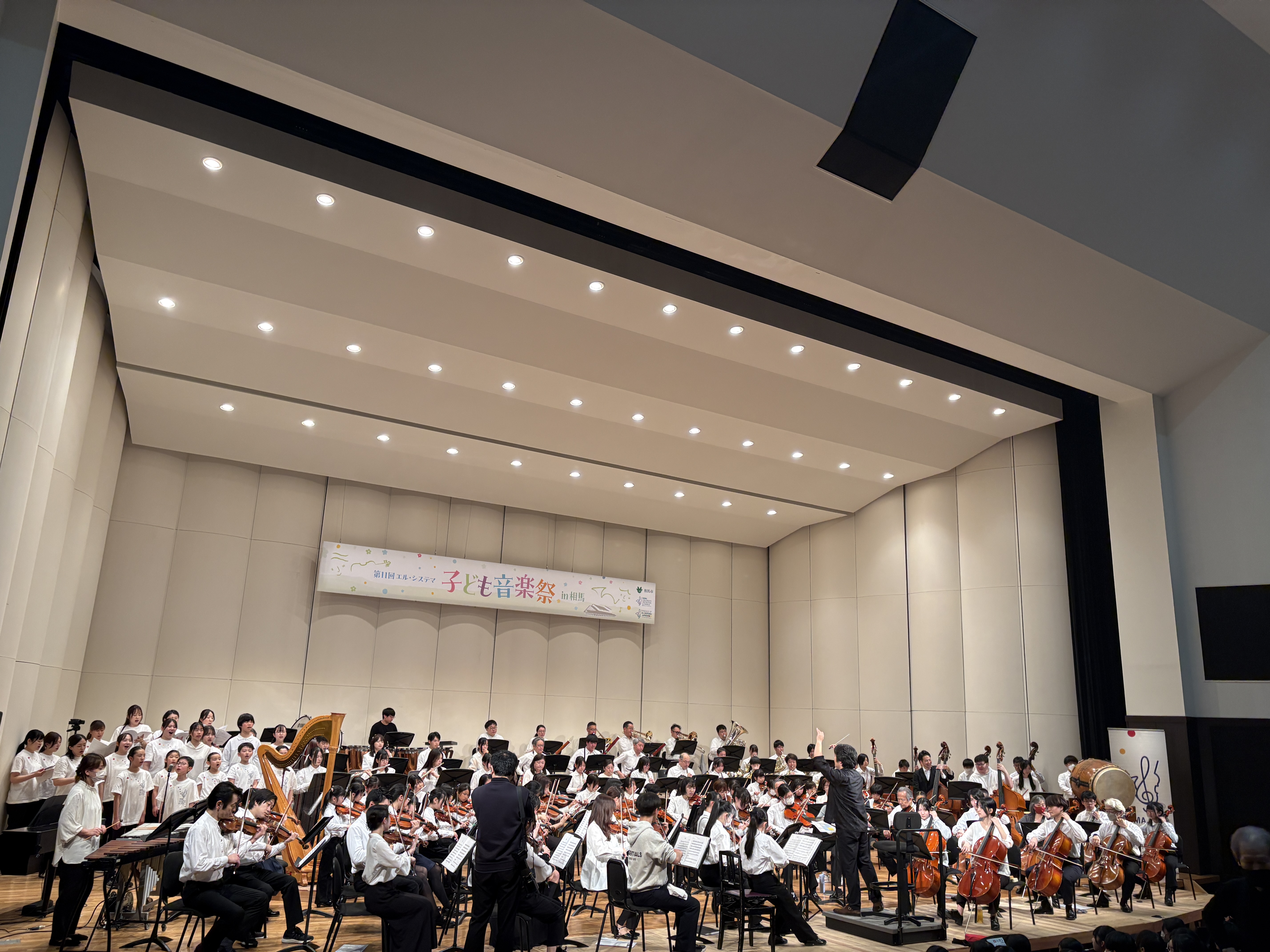
“Soma Bon-uta” encore at the 11th El Sistema Children’s Music Festival in Soma, 2026. Photo: El Sistema Japan.
The 11th El Sistema Children’s Music Festival in Soma, Japan, on the seacoast in Fukushima Province, has just come to a close. Nearly 700 audience members shared a priceless experience, immersed in touching, joyful, performances sung and played by children ages 6 to 18, together with graduates, teachers, and supporting professional musicians—approximately 200 performers in total. The audience smiled at the energetic, playful performances of the young musicians; wept in remembrance of lives lost; and rediscovered their love and compassion for their community.
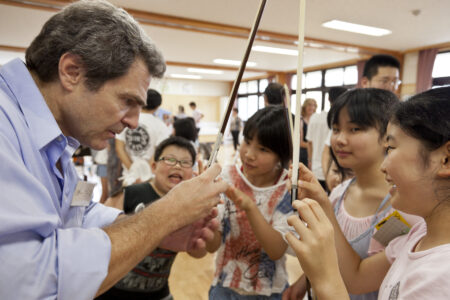
For me, the festival brought back memories of a cold winter day in December 2011, when I met with Soma City Council officials to explore the possibility of launching Japan’s first El Sistema–inspired program. At that time, children in Soma were still deeply affected by the 2011 Great East Japan Earthquake, tsunami, and subsequent nuclear power plant accident. Many had lost family members and friends; many faced widespread stigma and discrimination resulting from radiation contamination across Fukushima Prefecture, including Soma City. I was serving as Chief Coordinator of UNICEF’s post-disaster operations.
One of the officials present at that meeting was Mr. Tomio Ueda, then Director of the Agriculture and Fishery Department of Soma City Council. Despite being overwhelmed by the demanding task of monitoring radiation levels in all local food products, he kindly joined the discussion. A devoted music lover, Mr. Ueda ran a volunteer organization that planned and coordinated classical music concerts in Soma and was also a well-known local flute player. Through a documentary on Venezuela, he knew about El Sistema, and he told us that creating something similar for Soma’s children would be a dream post-disaster reconstruction initiative.
Also present was Mr. Takeshi Sato, then Supervisor of the Soma City Board of Education. Mr. Sato was my key counterpart in the City Council and the first person with whom I discussed the idea of El Sistema. With a background as a fine arts teacher, he had coordinated the “Eye See” project—one of UNICEF’s reconstruction programs—through which affected children learned artistic photography under the guidance of a professional UNICEF photographer. He was profoundly impressed by the quality of the photographs taken by local children, including one by his own child, and became convinced that the arts possessed transformative power even in times of hardship. “If we could achieve this with a photographer, and then with a musician,” he said, “we should be able to do the same through an El Sistema project.”
Fortunately, Soma already had a strong musical tradition across many fields. Local elementary and middle schools had long taken pride in their after-school string, brass, and choral clubs, some of which had achieved success at competitions. A yearly children’s festival was launched in 1995. Soma’s traditional folk songs are nationally renowned and faithfully passed down through generations. Above all, the community was rich in professional and amateur musicians who possessed both the skills and the commitment to work with children.
Because educational activities in rural areas of Japan, like Soma, are largely centered on the public school system, we carefully designed the program to support school clubs and in-class instruction. Over time, this expanded into community-based orchestras and choirs open to all children, regardless of school affiliation. The music festival has served as a unifying platform, bringing together students from El Sistema-inspired programs and existing school-based after-school clubs across Soma.
Organizing the festival has not been without challenges. Although Soma is a small city with a population of roughly 35,000, differing interests among stakeholders have at times clashed, particularly over fundraising, external communication, and repertoire selection.
Nevertheless, one tradition remains unchanged: the final encore is always “Soma Bon-uta,” a traditional folk song celebrating the harvest. Composed more than 200 years ago during a time of devastating famine, when Soma lost more than half of its population, “Soma Bon-uta” has become a powerful musical symbol and source of pride for residents.
Mr. Ueda played a crucial role in arranging the song into various formats—full orchestra, brass band, and choral versions—using prefectural government funding aimed at restoring Soma’s local identity in the face of post-nuclear accident stigma and discrimination.
At the end of that first conversation in 2011, after watching the famous Simon Bolívar Youth Orchestra’s Mambo trailer, Mr. Sato remarked, “One day, our children could create a stage this exciting, infused with our spiritual “Soma Bon-uta.” That would truly encourage the people and rejuvenate our community.”
This vision was realized once again at the 11th festival, where “Soma Bon-uta” closed the performance as the final encore. The audience clapped along, and the municipal hall erupted with thunderous applause. The Soma festival may be a small event in a small town, but it powerfully demonstrates how music can amplify human potential and strengthen community resilience.
Related Content
All Regions, Choir, Collaborations, Community Building, Europe, Events/Performances, Gather Together, News and Resources, North America, Professional Development, Strings
Applications Open for Youth Orchestra Summer Programs
Patrick Scafidi
All Regions, Collaborations, Community Building, Events/Performances, Gather Together, Latin America, News and Resources, North America, Professional Development
New Open-Access Report: “Intercultural Resonances among Music Teachers”
Patrick Scafidi
All Regions, Collaborations, Community Building, Europe, Events/Performances, Gather Together, News and Resources, Professional Development, Research
February 5 Deadline: 12th SIMM-seminar Expressions of Interest
Patrick Scafidi
Ambassadors, Collaborations, Community Building, Featured, Gather Together, Middle East, Perspectives & Collective Action, Student Voice & Leadership, Teaching & Learning, the world ensemble

In Jerusalem, a Space for Healing
Patrick Scafidi


