
Violin Included: Reflections on Leadership, Giving, and Growing Up in This Field
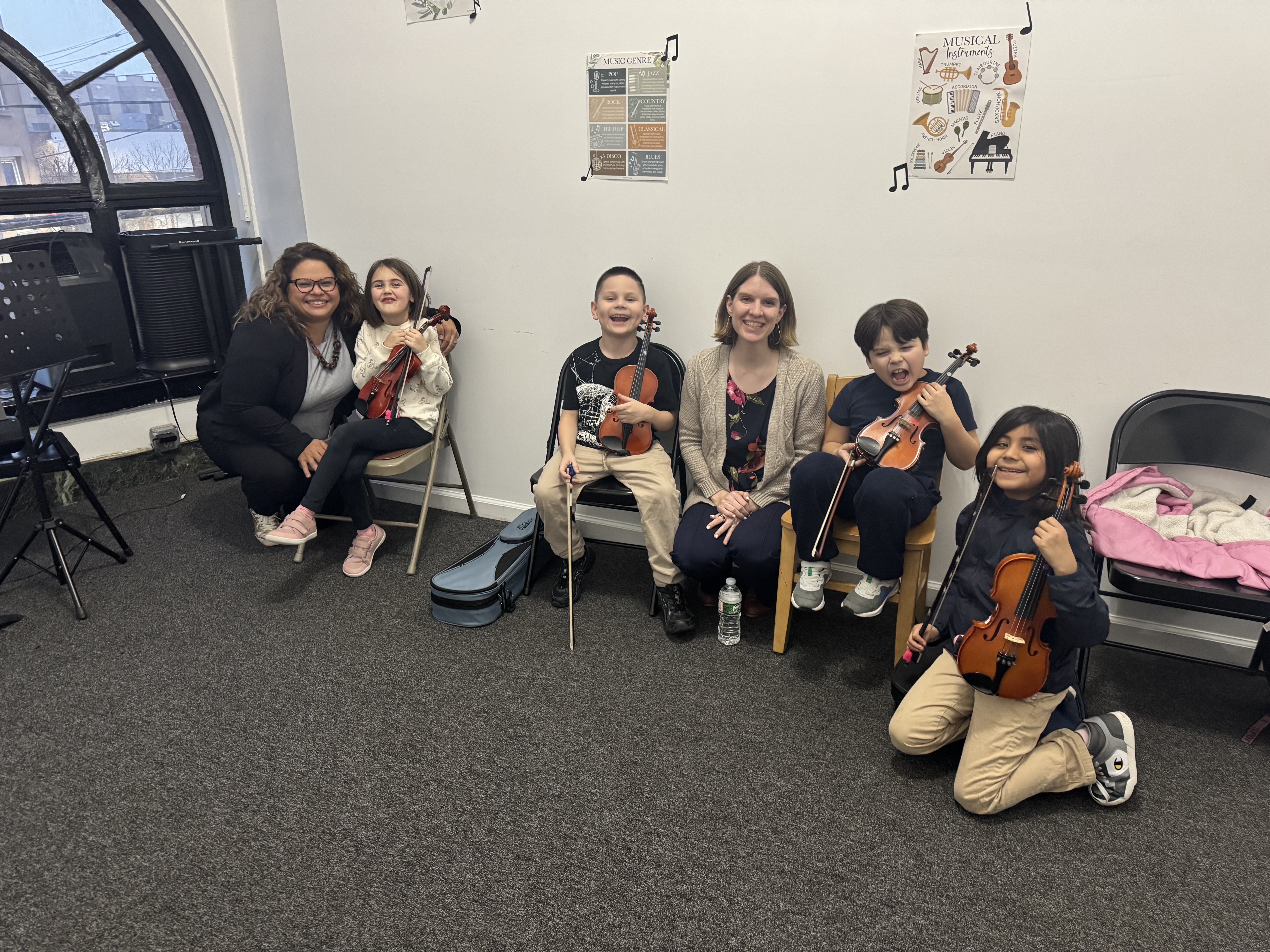
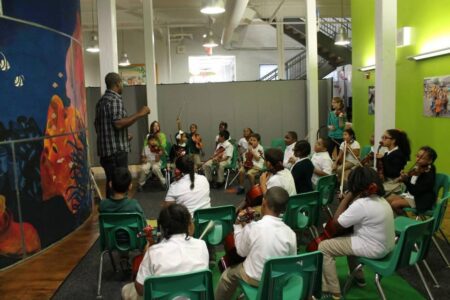
The author with young violinists at UCMP, with program founder/leader Melina Garcia, at left.
Last week, I found myself in Union City, New Jersey, USA—sitting in a sea of students, violin in hand, playing “Swan Lake” alongside kids, teachers, and my longtime colleague Melina Garcia. I hadn’t come to visit Melina and her program, the United Children’s Music Project, simply for the joy of playing with young people; I was there to deliver a donation. I had just closed a similar program in Pisco, Peru—Notes for Change, Inc.—that I founded 15 years ago, and my donation for UCMP consisted of the final funds from that program. I had expected this to be a bittersweet moment; instead, it felt like a full-circle one. But more about that later.
My journey in this work began when I traveled, as a college music education student, to Pisco, Peru, with my church, to provide aid in the wake of an 8.0-magnitude earthquake. I brought school supplies and good intentions—and my violin.
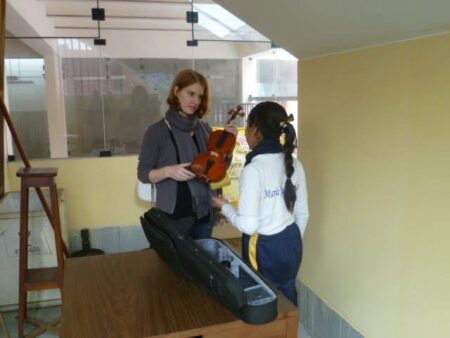
The devastation was staggering. Eighty percent of the city had been decimated; on any given block, you would see a house standing, and then a lot full of rubble. It was the first time I’d witnessed the aftermath of a natural disaster. It was shocking in every way.
My violin proved to be crucial on that trip. At every school visit, church service, and community gathering, I played. I started putting games and lessons from my music ed classes into action. The violin became a far more powerful tool for communication, connection, and healing than anything else we brought with us.
I went back to Pisco multiple times over the next few years. One morning over coffee, my parents and I started imagining what a long-term music project in Pisco could look like. By the time our mugs were empty, we had decided to form a nonprofit. I put on a fundraiser concert at my church in New Jersey, and also received a grant from Temple University; all in all, we raised $30,000, and Notes for Change, Inc. was born. I was 21.
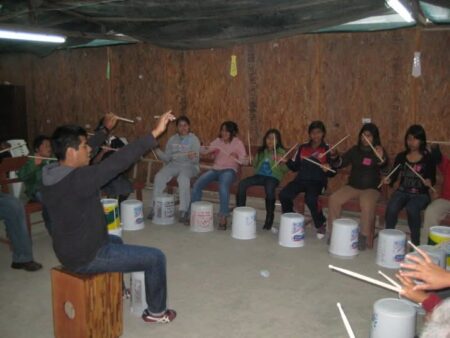
Over the next four summers, I brought teams of music education students from the U.S. to Pisco and ran programs for up to 50 kids at a time. The first summer, I recruited my now-husband Raul Huaman, a guitarist and music teacher born and raised in Lima, who became an essential partner and guide. Each summer, the program evolved, and we built a network on the ground to support it.
But I also began to understand some of the problematic power dynamics in what we had built. Raul once asked me: “Why does it always have to be people from the outside providing aid? This should be coming from within.” It was hard to hear, but he was right. The dynamic I had set up carried echoes of colonialism, although that had never been my intent. We tried to build local leadership and infrastructure into the Pisco Music Program, but it was hard to do so from a home base in New Jersey. So Notes for Change wound down our Pisco project, although we continued to support music-for-social change projects.
It was at that time that I was offered the opportunity to launch and build the Paterson Music Project with two of my best friends, who also happened to be my roommates. We had each been independently hired to start PMP (invite me out for a drink sometime and I’ll tell you what it was like to come home and discover we’d all gotten the same job).
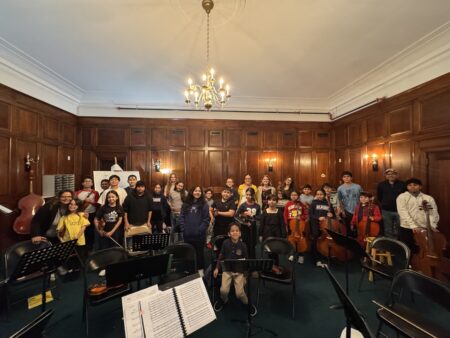
We started with 30 kids in a city where most students weren’t receiving any music education in school, due to budget cuts. For the first three years, we ran the program during the days and prepped for it in the evenings, at our apartment—repairing instruments and spending hours with calloused, papercut hands making paper instruments on our living room floor. We commiserated together after hard days and celebrated together after concerts when the kids had pulled off something beautiful. Here, too, I showed up with my violin, leading our jaunty version of Twinkle (“The Twinkle Tango”) at our community concerts. We loved every minute of it.
I was 23. I was green. And again, I had been given an extraordinary opportunity to try and build something. There was a lot we didn’t know. But we learned. And the program grew, quickly and organically.
Nearly four years ago, I moved on to serve as Executive Director at El Sistema USA. I don’t think of my new role as “a step up,” rather a step toward wider connectivity. National impact isn’t more consequential than local impact; it’s just different. In my current role, I spend much of my time thinking about how to leverage the collective impact of our network, creating benchmarks and thought leadership for programs across the country. It’s engaging and rewarding work. But stepping into a local program reminds me why all of it matters. When I visit programs, I’m always in awe of the direct, tangible, human work happening. You can feel it in the air when a program has created a real culture of community and trust between teachers, students, and parents.
This is how I felt when I visited the United Children’s Music Project last week. I knew I’d feel grateful that my final donation from Notes for Change could support UCMP’s efforts, even as I was sad to see Notes for Change close. But I didn’t expect to be so powerfully reminded of the lesson I had learned in Paterson—and, with Raul’s help, in Peru: that community leadership is essential for our programs.
At the beginning of my Union City visit, Melina spoke to the kids. “In this world, there is so much suffering,” she said. “But anyone can choose to do good and make change in their community. You can always be the helpers in this world.” Then she placed a violin in my hands and invited me to join the students in playing “Swan Lake.”
We all know the truth of Melina’s words: our students have the power, even at a young age, to be the helpers we look to. This work is about planting thousands of little seeds, so that our students can be the changemakers, healers, and leaders of the world. That is the spirit of our work: to build leadership from within, through music. Even as one chapter closes, we’ve opened up the possibility of a hundred more.
And here’s another thing I’ve learned, over these years: Always, bring your violin.
Contenido relacionado
América del Norte, el conjunto del mundo
¿Intencional o accidental? Crear una cultura organizativa poderosa
Patrick Scafidi

África, Embajadores, Asia, Asia/Oceanía, Europa, América del Norte
El intercambio de embajadores, mayo de 2019
Patrick Scafidi
Destacado, Financiación y apoyo, América del Norte, el conjunto
Los becarios de PlayUSA se centran en el arte y la pertenencia
Patrick Scafidi