Eric Booth



Suggested Listening: Get to Know an Ensemble Cofounder
For those interested in learning a bit more about the minds behind The Ensemble, our Cofounder Eric Booth recently guested on the A Culture of Possibility podcast.
EDITORIAL
Attending to the Skills of Attention
Eric Booth, Cofounder and Contributing Editor, The Ensemble; Cofounder, ITAC; Senior Faculty, AIM
“Spotlight attention vs. lantern attention.” I first encountered this distinction in the work of the U.S. psychologist Allison Gopnick.
Spotlight attention means bringing full focus to a specific task. We develop this capacity over time, and we must!—it’s hard to succeed in life without the ability to focus well. Schooling is dedicated to developing this capacity: all those hours sitting at a desk and “paying attention” to information that rarely feels relevant; all those tests to measure spotlight skills.
Sitting in the Student Seat at AIM’s Fire Up Residency
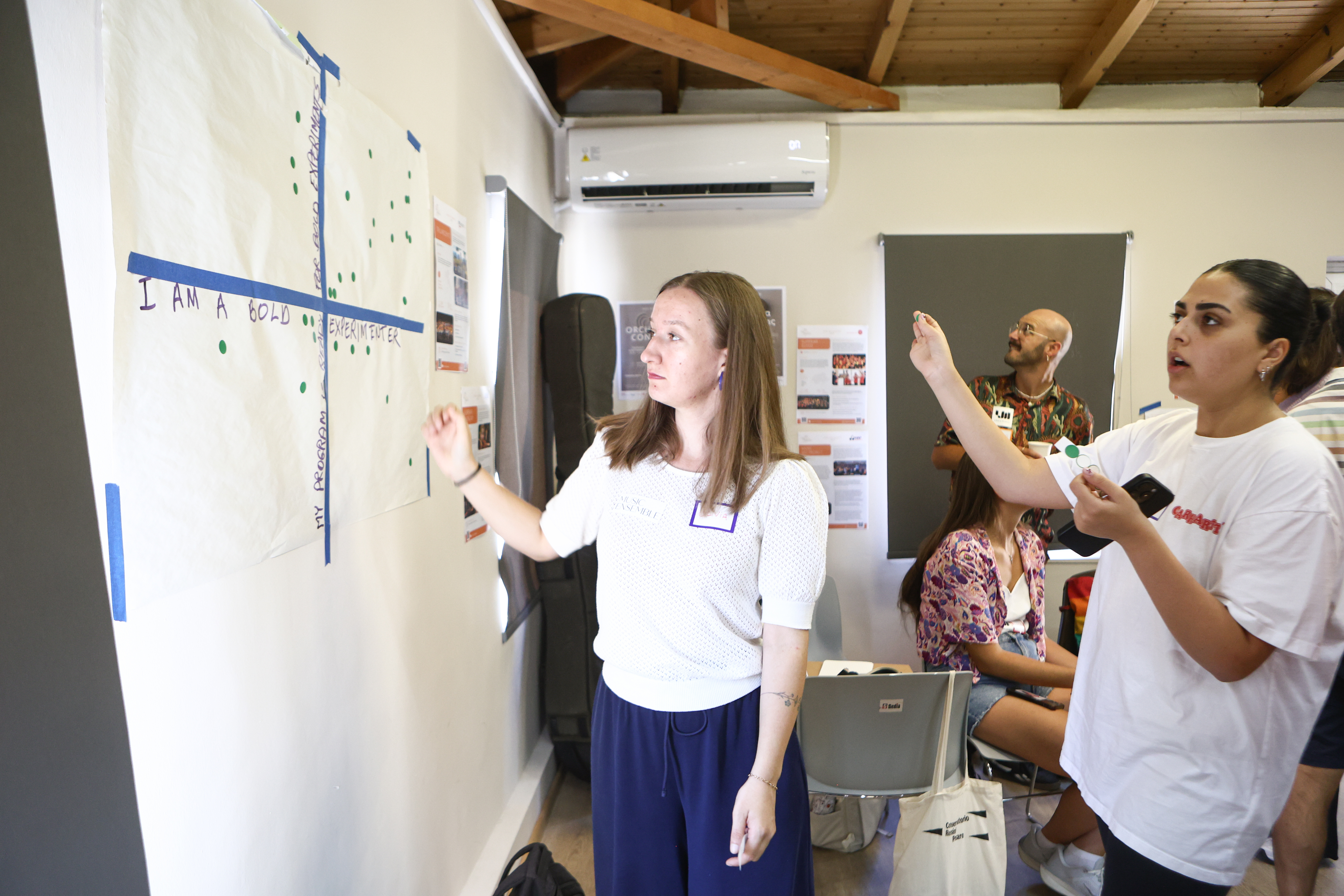
Olivia Romanet, Music Theory Teacher, MusicEnsemble, Conservatoire de Musique de Genève
That first day, I felt like a teenager: somewhat defiant, hesitant to initiate, eager to observe, even mistrusting…but also wanting to chat, meet people, laugh, and share.
AIM knew what they were doing. We’d found ourselves on the other side of the classroom, sitting in the student chair. And in experimenting with ways to develop our own community and agency—our capacity for action—as educators, we found ourselves viewing students’ needs with new empathy.
EDITORIAL
Teaching Artistry: West Meets East in Potential

Eric Booth, Co-founder, The Ensemble; Co-founder, ITAC; Senior Faculty, Academy for Impact through Music
Teaching artistry is the sleeping giant of social change.
And that giant is waking up. At least that’s what I claim, in my relentless advocacy for the global field.
A New Zealand “Pōwhiri” for Teaching Artistry

Eric Booth, Co-Founder, The Ensemble; Co-Founder, ITAC
A good conference asks an important question; a great conference launches an answering process that reaches beyond its few days. In September, ITAC7, the Seventh International Teaching Artist Conference, brought hundreds of teaching artists from around the world to Auckland, New Zealand, to address the question of what the global field can learn from Indigenous wisdom about art and community.
Ode2Joy Competition Winners Announced
The winning entries for the Ode2Joy competition are now online, celebrating the 200th anniversary of the first performance of Beethoven’s Ninth Symphony.
Suggested Reading: Making Change by Eric Booth
It’s been said that our very own Eric Booth wrote the book on teaching artistry. Well, now he literally has: Making Change: Teaching Artists and Their Role in Shaping a Better World is an accessible, practical guide to teaching artistry, offering an easy on-ramp to newcomers and lots of good advocacy tools to old hands.
Building Continual Improvement into Our Teaching

José Ángel Salazar Marín, conductor; Artistic Director, El Sistema Greece; AIM FAR Lab Leader, and Eric Booth, Cofounder, The Ensemble; leadership team, AIM (Academy for Impact through Music)
Action research is widely used in professional research, but unlike most academic research methodology, action research doesn’t stand back and wait for non-practitioners to deliver findings. Action research is led by the people inside the work, with ongoing hypotheses, experiments, and discoveries leading to improved practice along the way.
Flying Free

Eric Booth, Founder, International Teaching Artist Collaborative; Cofounder, The Ensemble
Last week, ITAC6—the Sixth International Teaching Artist Conference—brought together over two hundred teaching artists from 36 countries at a gathering in Oslo, Norway. During 60 in-person working sessions and many activities offered both in person and online, two clear messages rang out.
AIMing Forward: Introducing the Academy for Impact through Music

Eric Booth, Cofounder, The Ensemble; Senior Advisor/Lead Faculty, AIM
The global field of music for social change is committed, smart, resilient, and brimming with talented teachers, administrators, and students—that’s a lot of assets! But it isn’t organized to learn well and get better as a field. Indeed, as I traveled during the past decade to 25 countries to observe good programs in action, I consistently heard that their two greatest challenges were finances and faculty. These problems haven’t been getting better.


