Cultural Exchange


Call for Proposals: Spaces of Culture
Arts and cultural organizations in Sub-Saharan Africa interested in partnering with European artists and cultural professionals are encouraged to apply for EUNIC’s Spaces of Culture program.
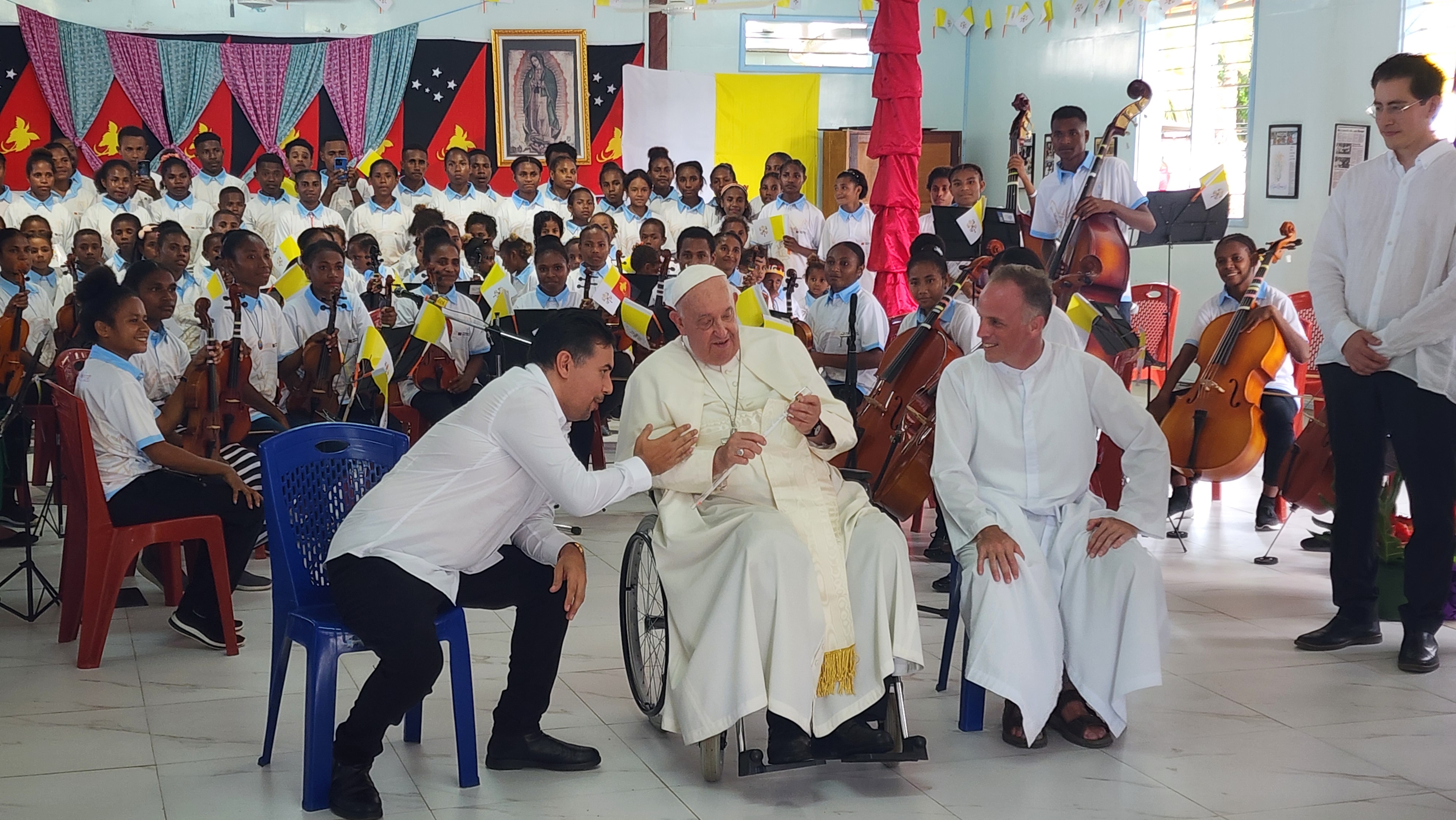
The Queen of Paradise Initiative: A Life-Changing Experience in Vanimo, Papua New Guinea
Dane Madrigal, composer, conductor, and music educator
One of the most memorable experiences from my time in Vanimo was helping the students prepare music for a truly special occasion: the visit, last August, of Pope Francis. With only three weeks to prepare, the students were able to put together both a fully recorded concert for the Holy Father and a few live pieces for his visit to the IVE Fathers in Baro.
A New International Center for Reconciliation through the Arts

Ismar Porić, Artistic Director of House of Good Tones, as told to editors at The Ensemble
Few would disagree that imagining and constructing something good for humanity, in a place where vast harm has been done, is a creative act. Therefore, the completion of The Ensemble House in Srebrenica, Bosnia and Herzegovina can be seen as one of the world’s great creative triumphs in recent years.
At Sirkhane Social Circus, Cultural Cooperation Is No High-Wire Act

Sahba Aminikia, San Francisco-based Iranian American composer; Founder, Flying Carpet Festival
Sirkhane Social Circus is more than just a place to learn circus skills—it is a sanctuary of joy, healing, and creative expression for children who have endured the trauma of war, displacement, and social instability. Based in Mardin, Turkey, near the Syrian border, Sirkhane provides a safe and nurturing environment where children from diverse backgrounds—Syrian, Turkish, Iraqi, and Kurdish—come together to learn, perform, and play.
Learning through Teaching with the AIM Firebirds

Pablo Millanes, AIM Specialist and Strategy; Director of External Relations and Marketing, Reina Sofia School of Music, Madrid, Spain
This past July, the warmth of the Portuguese summer and the backdrop of the Lisbon sea welcomed a diverse group of teachers and young musicians from social action music programs across more than ten countries. Amidst varied accents and curious glances, a shared energy became palpable—the excitement of face to face meetings among people who had been able to interact with one another only virtually during their four months of preparation. There was also the shared enthusiasm of people doing what they love most: teaching and making music together.
The Citizens of the World Festival

Lauren Rausch, YOLA National Festival Violin Faculty
For the last eight years, I’ve coached violinists for the YOLA National Festival. Each summer, it is a remarkable thing to walk into the first sectional on the first day and witness an exceptional level of preparation from 18 violinists who, for the most part, don’t know each other and have never played together—a group of students that have made a commitment to each other before even meeting one another. This is what defines the YOLA National Festival: the dedication and integrity of all participants, a spirit that lives in the YNF students and also in the staff and the incredible faculty who return each summer. It is a special and profoundly devoted community, something I have not witnessed elsewhere.
World Orchestra Week at Carnegie Hall

James Ross, Orchestra Director, NYO-USA and NYO2-USA; Music Director, Alexandria Symphony, VA, USA; Director of Orchestral Studies, Curtis Institute of Music
Carnegie Hall’s World Orchestra Week festival in August was a week of one “WOW!” after another, as seven youth orchestras from five different continents joined forces in and around Carnegie Hall to play for and with each other, to share singular musical works and ethos from their countries, and to show us all what the next generation’s Wishes for Our World might be.
Bridging Cultural Identities through Music

Fenia Biniari, Communications Manager, El Sistema Greece, Alexandros Gkonis, Greek composer, and Hasan Labendz, musician, El Sistema Greece
An artist’s creative process is one of the most intriguing aspects of a composition—a giant basket of sights, sounds, ideas, and sensations that bring inspiration. But how do artists select and interpret these elements? And if they really are so personal to us, what happens when we share the contents of those baskets with others?
At El Sistema Greece, the B-Me: Blending Melodies – Bridging Cultural Identities project has given us a window into that process.


