


Topics
News & Resources
From an Empty Airport to Downtown Berlin, a Music Program Still Soars
Tricia Tunstall, Co-founder and Advisory Editor, The Ensemble
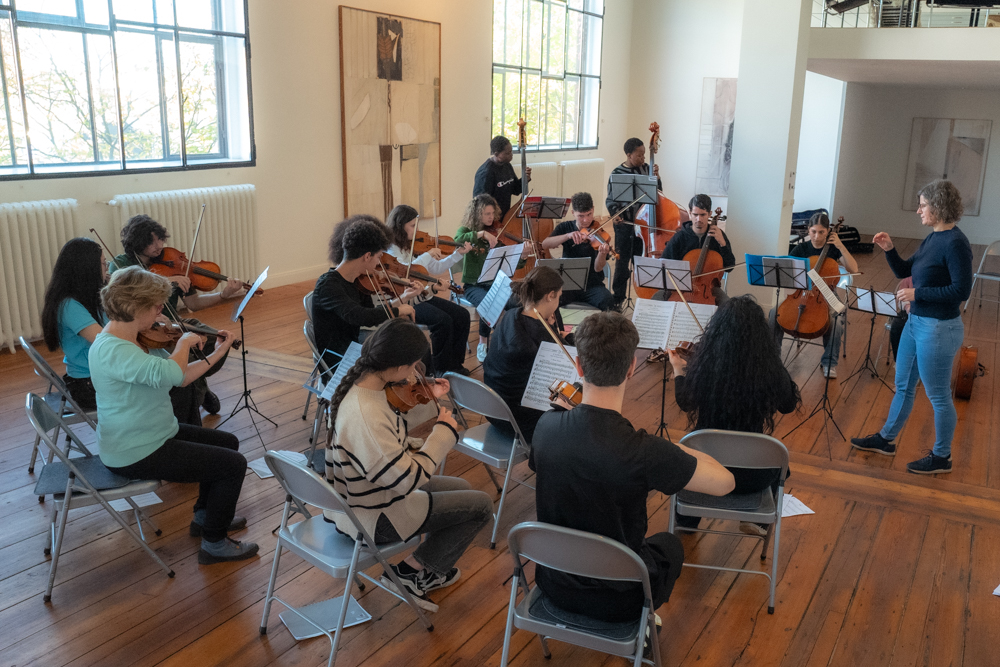
Artistic director Leila Weber conducts a Hangarmusik ensemble, with the helpful presence of a visiting artist from Freiburg (aqua shirt).
In a white-walled, sunlit room with arched ceilings, an El Sistema-inspired youth orchestra plays Gustav Mahler’s well-known “Bruder Martin” (“Frère Jacques”) theme—the third movement of his Symphony No. 1—under the direction of teaching artist/conductor Leila Weber. The two double bass players are six feet tall, around sixteen years old; the youngest cellist might be seven, and this is the second time she’s held a cello. Embedded among the second violins is a guest teaching artist from an orchestra based 500 miles away.
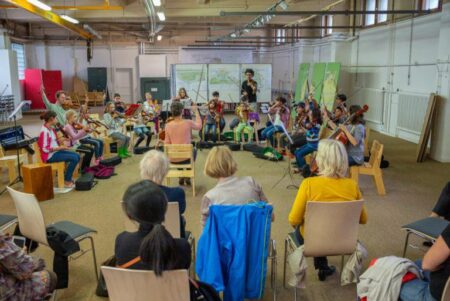
The ensemble’s intonation isn’t perfect, but the music sounds even more somber, more melancholy, than it does when played by professional orchestras. Most of the young musicians are from refugee families; many live in circumstances where there is little or no access to classical music education.
This is the Hangarmusik program in Berlin, Germany, founded in 2016 by Andreas Knapp and Leila Weber; they still lead the program, with Weber as artistic director and Knapp as co-director. The program’s name refers to its original location: a hangar in the former Berlin-Tempelhof airport, where 3,000 refugees were temporarily housed. Knapp and Weber started the project to provide music as well as literal shelter. “We wanted to fill the empty hangars with classical orchestral music made by the children,” they tell me.
As the program grew over the next five years, it occupied various spaces in the former airport: Hangars 6 and 7, a customs garage, and a container village on the airport ramp. In 2021, Hangarmusik finally moved into the city. That sun-filled rehearsal space is part of an ivy-covered Victorian building, “Camaro Haus,” which began as Germany’s first art institute for women. The walls are hung with works by German artist Alexander Camaro: large, figurative paintings in tones of beige and brown.
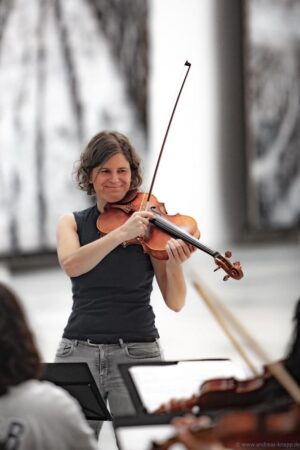
After the Mahler (and an extemporized “Happy Birthday to You” for visiting guest Eric Booth), the young musicians work on a Renaissance secular motet transcribed for orchestra. Music director Leila Weber grabs her viola and changes positions with the teaching artist from the Freiburg Baroque Orchestra, who coaches the young musicians in phrasings and then asks them about the mood of the piece. “Traurig (sad),” says one of the bass players, and his orchestra mates agree. One of them says that playing sad music makes her feel less sad.
Classical orchestral music has always been the repertoire of choice for this program. The participants have many other rich musical traditions, but the Hangarmusik team believes that welcoming them into classical music is a form of welcoming them to Germany. Each child is introduced to an orchestral instrument from day one and learns to play within the context of teachers and peers. Playing together promotes social competences and helps the children to feel they are part of a community. “The beautiful thing,” Leila and Andreas say, “is that it’s not about competition.”
The program also offers opportunities to play alongside other local youth ensembles and, sometimes, to play with professional musicians. The ethos at the heart of all activities of Hangarmusik is to ensure that the participants gain a wide and varied experience of the world of classical music and of the world at large.
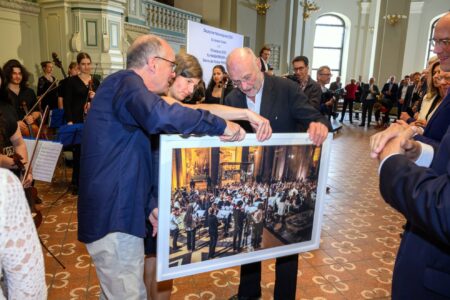
In one memorable instance of enlarging horizons, the members of Hangarmusik were invited by the renowned German artist Anselm Kiefer to travel to Provence, France in 2024 to play at his Eschaton-Foundation. They played music by Mahler, Sibelius, Elgar. Rameau, and Händel—and, in addition, a piece they collectively composed for the occasion.“It sounded like Webern!“ the directors tell me proudly.
In addition to the children and young people who come to the program in Camaro Haus, Hangarmusik also works in various refugee shelters in Berlin. Sometimes, students may leave the program because of life circumstances or because their families have been transferred to other areas in Germany; usually, though, they come back or keep in touch.
In the rehearsal room, the young musicians play their Renaissance motet one more time. The phrasings are precise; the vibrato is spare, in keeping with the genre. As they end the piece, they hold their bows aloft for a moment. We can all feel it: they’ve learned to listen to the silences after the music ends.
Related Content
Asia, Asia/Oceania, Opinion, Perspectives & Collective Action, Teaching & Learning
From Lapu-Lapu to Toledo: The Influence of El Sistema in Cebu, Philippines
Axelle Miel

Ambassadors, Collaborations, Europe, Student Voice & Leadership, Teaching & Learning
Brazil to the Silk Road, Handmade Drums to Pro Tools: How two youth music organizations in the UK are maintaining engagement and exploring new territory
Matthew Jones
Africa, Ambassadors, Community Building, Student Voice & Leadership
Ghetto Classics Update
Stephen Ongoma
All Regions, Ambassadors, Collaborations, Community Building, Student Voice & Leadership
Quarantunes Playlist from The Ambassadors
Axelle Miel


